

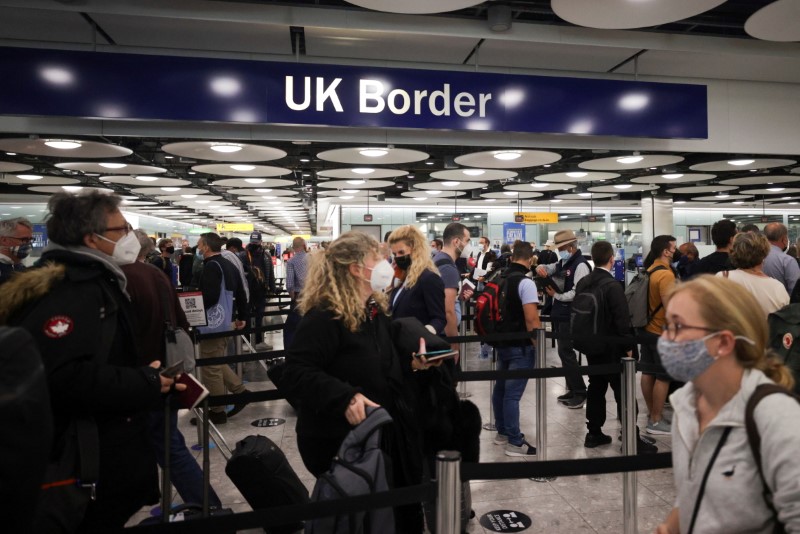
The government of the United Kingdom (UK), through the Home Office, has set out a formal framework for Immigration Enforcement to use live facial recognition (LFR) across the country.
Pan-Atlantic Kompass reports that live facial recognition in the UK is used mainly as a precision tactic to find people trying to return in breach of a deportation order, or wanted on warrant or liable for arrest for an immigration-related criminal offence.
Cameras compare disembarking passengers against a watchlist of such individuals. The system compares a live camera feed against a predetermined watchlist in real time and raises an alert on a possible match.
A trained Immigration Enforcement officer decides whether an alert is accurate.
The policy rollout comes after a short proof-of-concept trial began at Holyhead port on 10 November 2025, using equipment from South Wales Police and Greater Manchester Police.
It followed controversy over illegal immigration, including a BBC report of a deported man who returned by small boat. A further Holyhead trial with Border Force was scheduled for the week of 23 February 2026.
However, the results have been contested. A report in February 2026 revealed that a scan of thousands of Dublin–Holyhead passengers cost tens of thousands of pounds and produced no matches. The Home Office said it doesn’t comment on operational matters, and called LFR essential to safeguarding the integrity of the immigration system. One traveller said the technology had misidentified him as another person of South Asian heritage, and called it “stop and search on steroids.”
Meanwhile, the Home Office, in its policy, has now clarified the operations of live facial recognition in the UK.
The operation is set to be deployed beyond ports of entry, including transport hubs and joint deployments with police, while establishing safeguards intended to ensure that facial recognition is used lawfully and proportionately.
The new guidelines instruct IE staff on “how to use overt LFR to locate relevant people lawfully and ethically” and “support IE’s and the Home Office’s legitimate immigration enforcement aims. It provides a summary of the operational use of LFR and the governance and oversight applied.
“IE staff must follow the agreed LFR policies and processes,” it says. “This helps IE use LFR lawfully and effectively, with appropriate safeguards, and helps maintain trust and confidence among the public, partners and other stakeholders.”
To that end, the document lays out step-by-step protocols on “how the IE Live Facial Recognition (LFR) policy works from lawful purpose to accountable deployment,” in addition to a host of safety and governance considerations.
Defining lawful purpose comes first. Then, it is determined who is eligible to be on an LFR watchlist. Watchlists are compiled with safeguards applied, requiring them to be linked to a defined deployment objective, location, and context; time-limited; and proportional, with a necessity and proportionality assessment completed. Use must be overt and subject to human decisions about engagement or enforcement.
Images of people who do not generate an alert are “automatically and permanently deleted,” and deployments must be “monitored, reviewed and accountable.”
The statement reads in part: “Immigration Enforcement undertakes both administrative immigration functions and criminal law enforcement functions. Where Live Facial Recognition (LFR) is deployed to support administrative immigration activity, including detention or removal under Schedule 2 or Schedule 3 to the Immigration Act 1971, the associated personal data processing is governed by the UK General Data Protection Regulations and Part 2 of the Data Protection Act 2018.
Where LFR is deployed for the prevention, detection, investigation or prosecution of criminal offences, or the execution of criminal penalties, the processing is governed by Part 3 of the Data Protection Act 2018 (law enforcement processing).
This policy applies to both regimes. For each LFR deployment, the applicable processing regime, legal basis, and safeguards must be identified, recorded, and authorised in advance, by reference to the primary purposes of the deployment.
2. How the IE Live Facial Recognition (LFR) policy works from lawful purpose to accountable deployment
1. Lawful purpose is defined first
(Why LFR is used)
Live Facial Recognition may only be used where Immigration Enforcement has a clear, lawful immigration or criminal law enforcement objective, such as:
Giving effect to deportation orders or court warrants
Locating individuals lawfully sought for active enforcement or prosecution
LFR is never used for:
Intelligence gathering
General monitoring
Speculative or exploratory purposes
2. Eligible individuals are defined
(Who may be on a watchlist)
Only individuals who fall within strict, objective and predefined categories may be included on an LFR watchlist, for example:
Persons subject to an extant Deportation Order
Persons wanted on a UK court warrant for an immigration related offence
Persons actively sought for immigration enforcement or removal action, who have failed to comply with immigration conditions of entry or stay or lawful directions, and where their location cannot reasonably be achieved by less intrusive means
Intelligence may inform where and when LFR is deployed. Individuals may be included on a watchlist only if they meet the objectively defined categories in Section 9; intelligence must not be used in isolation to create eligibility or to expand those categories.”