

New UK Visas and Immigration (UKVI) briefing data reveals that 79% of prospective students who called for a credibility interview over six months in 2026 were deemed non-credible and refused entry.
Between May and October 2026, UK case officers conducted 11,415 student visa credibility interviews.
Of those applicants, 9,043 failed to satisfy genuine student requirements during the interview, marking a 79% rejection rate for students and a sharp escalation in UK visa scrutiny across major recruitment markets.
While UKVI officials cautioned that the six-month snapshot may not reflect full-year averages, the findings underscore mounting pressure on both international applicants and UK higher education institutions navigating tighter Home Office compliance rules.
Data from the UKVI study sector briefing highlights steep rejection rates among interviewees from South Asia and West Africa.
Nepalese students were the most likely cohort to be denied a visa after an interview, with 92% of students deemed non-credible by UKVI caseworkers. This was followed by India (89% of interviewed students rejected), Nigeria (84% of students rejected), and Bangladesh (79% of students rejected).
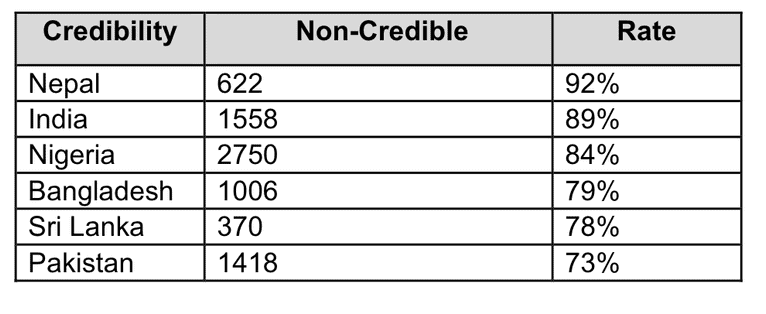
Meanwhile, 79% of Sri Lankan students were rejected after their interview, followed by 73% of Pakistani students.
UKVI stressed in the briefing that the data only covered six months and therefore was not necessarily representative of an annual picture.
The briefing document also revealed sharp rises in the likelihood of certain cohorts being called to interview. For example, between 2025 and 2026, the proportion of Nigerian students invited for an interview rose sharply – from 7% to 21%.
UKVI said this reflected “evolving patterns and our understanding of risk within the route”.
“We have seen an increase in applications from Nigeria where further scrutiny is needed, resulting in a greater proportion of applicants being invited to attend a credibility interview,” it added.
UKVI advised that the most common reasons for a visa refusal on credibility grounds between May and October 2026 included a lack of research about the student’s chosen institution, not being able to clearly explain why they have chosen to study in the UK and how their preferred institution and program “align with their plans”.
Other reasons included a lack of knowledge about their chosen program or subject, their English language ability, and the credibility of their funds.
Pan-Atlantic Kompass had reported the most bizarre reasons students have been given after being rejected on credibility grounds. These included not knowing how many trees were on their chosen institution’s campus and not knowing where the nearest bus stop was.