
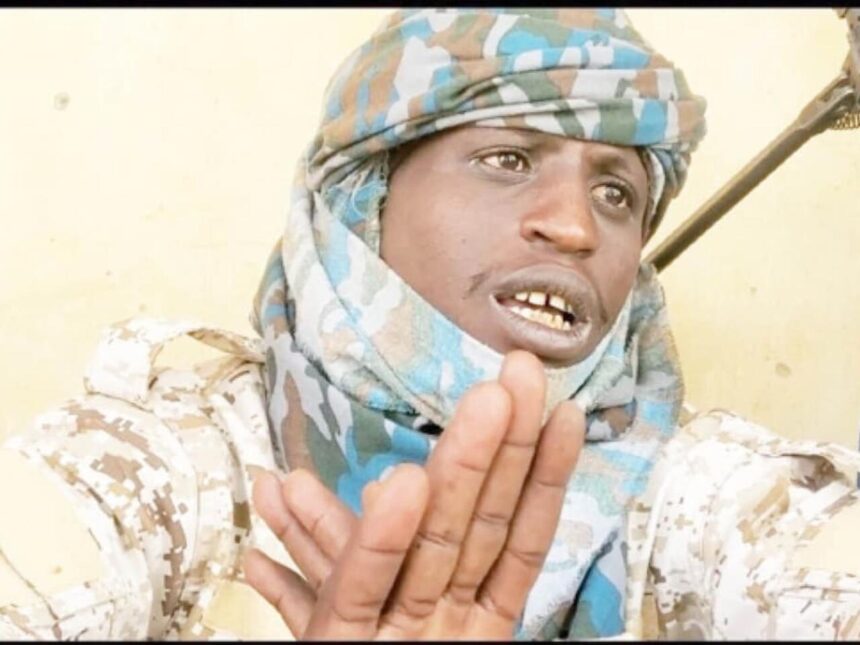
Notorious bandit leader, Bello Turji, has confirmed that he held peace negotiations with the Zamfara State Government during the administration of former Governor Bello Matawalle, who now serves as the Minister of State for Defence.
In a new, widely circulated audio message, the bandit kingpin acknowledged that he was engaging in talks with Matawalle as part of a peace initiative aimed at curbing the violence in the state.
However, Bello Turji, in the audio message, vehemently denied claims that he received N30 million payoff or any material benefits, urging the arrest of the officials who brokered the deal and past political leaders he accused of fueling the crisis.
Turji made this known while reacting to claims by Musa Kamarawa, a former peace mediator appointed by the Sokoto and Zamfara state governments to facilitate non-kinetic dialogue with armed bandits in the North-West.
Kamarawa had alleged that the Matawalle administration held several meetings with bandits, including Turji, at the Government House in Gusau, during which money and vehicles were allegedly shared. He specifically claimed that Turji received ₦30 million during the peace process.
However, Turji dismissed the claims as false, insisting that while peace talks indeed took place, no money or vehicles were given to him or any Fulani leader.
Turji stated: “By Allah, since I was born, I have never possessed even five million naira.
“What I am doing is not for personal gain. We were never given the ₦30 million being mentioned.”
According to him, the meetings were aimed at reducing violence in Zamfara State, and he added that Kamarawa had betrayed the trust established during the negotiations by making what he described as false and misleading claims.
“We agreed on peace when the Zamfara State Government appointed you. But what you are saying now is full of lies and deceit. I did not even receive three million naira.”
The bandit leader also accused some former political leaders in Zamfara and Sokoto states of contributing to the insecurity crisis long before Matawalle’s administration. He alleged that the arming of vigilante groups such as Yan Banga and attacks on Fulani communities worsened the conflict.
Turji specifically named former Sokoto State governor, Attahiru Bafarawa, and former Zamfara State governor, Senator Ahmed Sani Yerima, calling for their arrest and investigation.
“We say openly that former governors of Zamfara and Sokoto — Bafarawa and Ahmed Sani Yerima — are responsible for the calamities that befell these states,” he claimed.
He, however, sought to distance himself from political interests, insisting that he was not acting on behalf of any politician.
“We are not politicians, and we are not tools of politicians,” Turji said. “There is no human being backing us.”
Pan-Atlantic Kompass reports that Bello Turji had been declared wanted by the Nigerian military over terror-related activities.
Nigerian security agencies have repeatedly identified him as one of the most dangerous armed group leaders operating in the North-West.
His remarks also come as Nigerians have demanded the sacking of Matawalle over his comments on bandits in Nigeria.
A video recorded by Channels TV in 2021 captured Matawalle, who was then the Governor of Zamfara State, defending bandits in the state.
While answering questions from journalists on the activities of bandits in Zamfara State, Matawalle said “not all of them are criminals”.
“Not all of them are criminals. If you investigate what is happening and what made them take the law into their own hands, some of them were sometimes cheated by a so-called vigilante group.
“They normally go to their settlements and destroy property and take their animals. They did not have anyone to speak with, so sometimes, they go for revenge. When the vigilante group attacks them, they go for reprisals. That is exactly what happened,” Matawalle said.