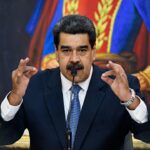

United States President Donald Trump announced on Saturday, January 3, 2026, that the U.S military forces had captured Venezuelan President Nicolas Maduro and his wife, Cilia Flores, during a military operation.
It was gathered that the U.S captured Venezuelan President Maduro and his wife during what has been described as a “large-scale strike” across the Venezuelan capital of Caracas.
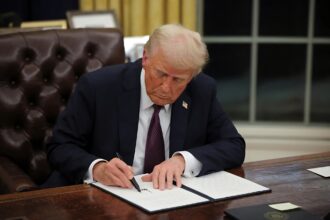
Trump made this known on his official Truth Social account on Saturday.
The post reads: “The United States of America has successfully carried out a large-scale strike against Venezuela and its leader, President Nicolas Maduro, who has been, along with his wife, captured and flown out of the Country.
“This operation was done in conjunction with U.S. Law Enforcement. Details to follow. There will be a News Conference today at 11 A.M., at Mar-a-Lago. Thank you for your attention to this matter! President DONALD J. TRUMP.”
Further information emerging on Saturday revealed that the couple was apprehended by elite forces and immediately flown out of the country.
Trump speaking with the press on Saturday said that Maduro and his wife were taken by helicopter to the U.S.S. Iwo Jima.
“Yes, the Iwo Jima,” Trump said. “They’ll be heading into New York. The helicopters took them out, and they went by helicopter on a nice flight. I’m sure they loved it, but they’ve killed a lot of people.”
“Even people in their own country. They killed a lot of people to maintain power. He’s a very vicious person.”
It was also gathered that Venezuelan President Maduro was captured early Saturday morning by members of the Delta Force.
The elite Army Delta Force was also responsible for the 2019 mission that killed former Islamic State leader Abu Bakr al-Baghdadi.
The operation began under the cover of darkness around 2:00 AM local time.
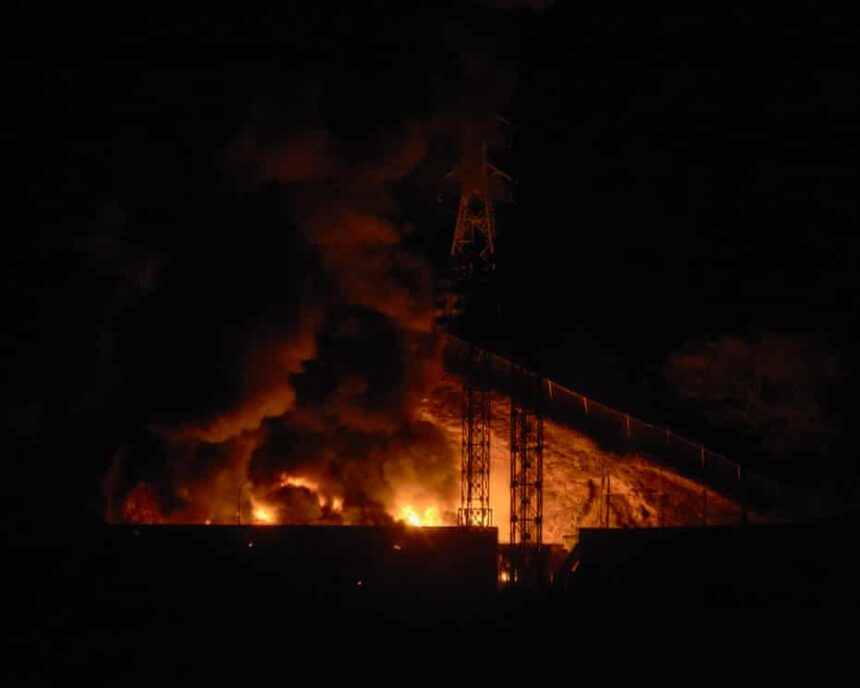
Residents in Caracas reported hearing at least seven massive explosions and the roar of low-flying aircraft sweeping through the city. Key military installations, including the La Carlota air base and the Fuerte Tiuna military complex, were reportedly targeted to disable the country’s defense systems.
Pan-Atlantic Kompass reports that the capture of Maduro serves as the culmination of a legal pursuit that began years ago.
Maduro was indicted in an American court for alleged narcoterrorism in 2020, with the U.S. Department of Justice accusing him of leading the “Cartel of the Suns” and conspiring with the FARC to “flood the United States with cocaine.” Since that indictment, the U.S. had placed a $25 million bounty on his head,
In a swift move, the Venezuelan government, led in the interim by Vice President Delcy Rodríguez and Defense Minister Vladimir Padrino López, has condemned the U.S government after its capture of President Maduro, describing the move as a “grave military aggression” and a violation of international law.
Venezuelan Defense Minister immediately announced a deployment of military forces across the country in a video posted to social media early Saturday, after the U.S. military conducted strikes on the country.
The defense minister called for a united front of resistance in the face of “the worst aggression” ever against Venezuela. He said all armed forces would be deployed following “Maduro’s orders” — but made no mention of Maduro’s reported capture.
“They’ve attacked us but they will not subdue us,” he said.
He called for calm and unity, and warned against anarchy and disorder, cautioning: Let’s not succumb to the panic the enemy seeks to instill.”
Venezuela’s government also called on its supporters to take to the streets in the wake of the U.S. military strikes early Saturday.
The statement said President Nicolás Maduro had “ordered all national defense plans to be implemented” and declared “a state of external disturbance.”