
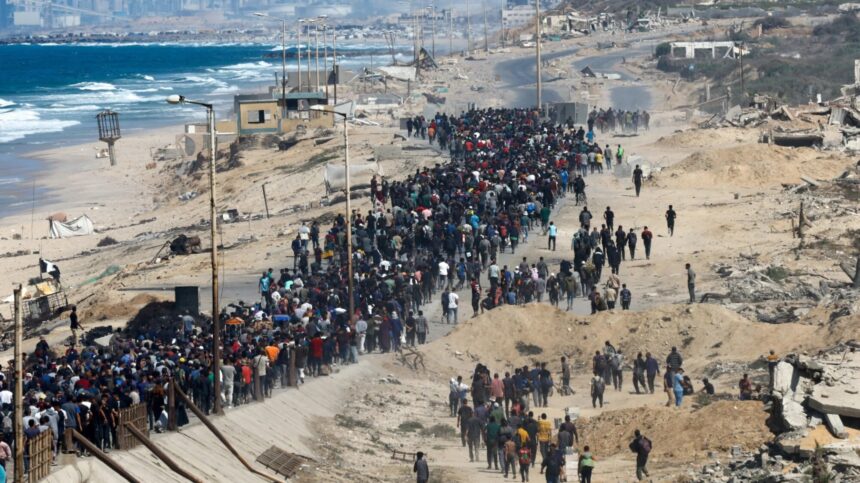
Thousands of displaced Palestinians have begun returning home as the third Israel-Hamas ceasefire takes effect today, October 10, 2025.
This marks the first halt in fighting since March and offers a glimmer of hope after two years of relentless conflict that has reportedly claimed over 67,000 lives.
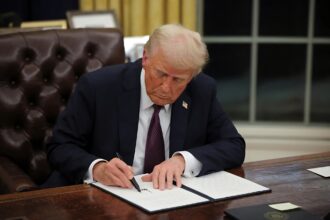
The third Israel-Hamas ceasefire came after the United States President Donald Trump unveiled a 20-point peace framework.
Following the development, officials of Israel and Hamas met in Egypt to ratify the ceasefire deal.
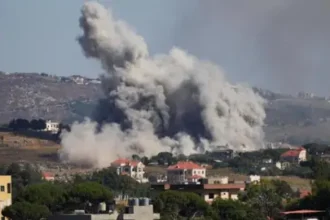
With the third Israel-Hamas ceasefire beginning, Israeli forces have begun withdrawing from key positions in northern Gaza, opening corridors for civilians to traverse the devastated landscape.
Israeli troops were seen pulling back from areas such as the eastern part of Khan Younis, southern Gaza, and the Nuseirat camp in central Gaza, but troops were still visible in other parts of the strip.
Hamas, in turn, has 72 hours to release the 20 remaining living Israeli hostages, in exchange for Israel freeing 250 Palestinian prisoners serving life sentences and 1,700 others detained during the war.
It was also gathered that celebrations erupted in Tel Aviv’s Hostage Square and Khan Younis, but for many in Gaza, the focus is on reclaiming what remains of their shattered lives.
Gaza’s civil defence agency has also confirmed the third Israel-Hamas ceasefire deal.
The agency revealed that Israeli troops and armoured vehicles were pulling back from forward positions in both Gaza City and Khan Yunis.
Also, a 32-year-old Ameer Abu Lyadeh, who spoke with the press said: “We’re going back to our areas, full of wounds and sorrow, but we thank God for this situation.
“God willing, everyone will return to their areas. We’re happy — even if we return to ruins with no life, at least it’s our land.”
“Thank God my house is still standing,” said 40-year-old Ismail Zayda in the Sheikh Radwan area of Gaza City. “But the place is destroyed, my neighbours’ houses are destroyed, entire districts have gone.”
Speaking also on the ceasefire, Israeli Prime Minister Benjamin Netanyahu claimed credit for the hostage release, saying in an address on Friday that the “security of Israel” was what dictated his actions in Gaza.
Netanyahu defended his country’s offensive in Gaza, saying it was both military and diplomatic pressure on Hamas that resulted in an initial agreement on a plan to end the war and see hostages released.
“I believed that if we applied heavy military pressure on Hamas — together with heavy diplomatic pressure — we could also bring back all our hostages. And that is exactly what we did,” he said today in a statement to the media. “But I also tell you — to put it mildly, it was not easy. I had to stand up to enormous pressures, both from home and from abroad.”
Meanwhile, an Israeli government spokesperson Brig. Gen. Effie Defrin, speaking on Friday revealed that Israeli forces will remain in control of 53% of Gaza in the initial withdrawal phase before the hostages are released.
He also stated that the ceasefire in Gaza “is an emotional moment for the people of Israel,” and for Israeli soldiers.
“We will do everything possible to protect the security of the residents of the western Negev, the south, and the entire country,” Brig. Gen. Effie Defrin said at a news conference, according to The Times of Israel.
Pan-Atlantic Kompass reports that the third Israel-Hamas ceasefire came after the first two broke down.
The first ceasefire began six weeks into the war, on Nov. 24, 2023. An initial four-day pause was agreed to and extended twice, during which 70 Israeli hostages held in Gaza were exchanged for 210 Palestinian prisoners in Israel. Fighting resumed on Dec. 1.
The two sides agreed to a second ceasefire lasting 42 days in January. The pause was planned to be the first phase of a longer-term deal, during which negotiators would seek to bring a permanent end to the war.
In that ceasefire, 38 Israeli hostages and five Thai hostages were released in multiple rounds of exchanges, as well as the bodies of eight hostages. A total of 1,755 Palestinian prisoners were released by Israel. The ceasefire also saw a notable increase in deliveries of humanitarian aid into Gaza, as well as the return of thousands of displaced Palestinians to their homes in northern Gaza.
The ceasefire ended abruptly on March 18, when Israel launched a wave of airstrikes on Gaza. Israel and the Trump administration blamed Hamas for the breakdown, saying the militant group refused Israel’s demand to release more hostages in exchange for the resumption of talks. Hamas rejected the demand as it had not been part of the original January ceasefire agreement.
Israel’s two-year military campaign in Gaza killed more than 67,000 Palestinians and wounded nearly 170,000 more, according to the Gaza Ministry of Health. Tens of thousands more bodies are expected to be buried under the rubble.
Israel launched the war in response to a Hamas-led attack on 7 October 2023 that killed about 1,200 people and took 251 hostage.
A UN commission of inquiry and several human rights bodies have accused Israel of conducting a genocide in Gaza over the past two years. Israel denies the accusation and says it has only acted in self-defence.