
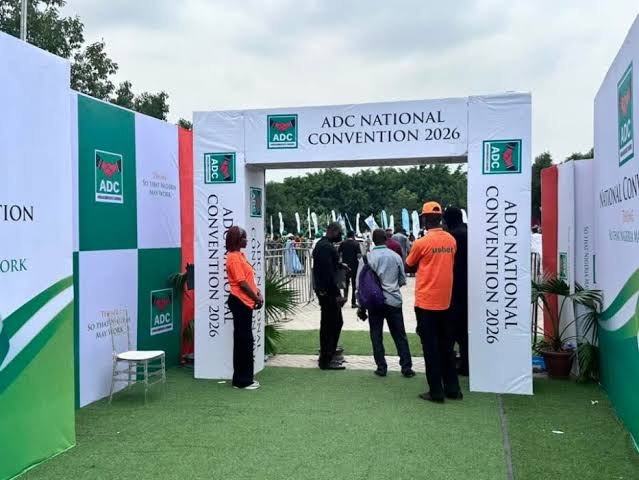
The African Democratic Congress (ADC) has officially concluded its highly anticipated national convention in Abuja ahead of the 2027 general elections.
The ADC held its National convention in Abuja amid a crisis rocking the party. Recall that the Independent National Electoral Commission (INEC) had recognised the David Mark-led leadership of the party citing a court ruling.
The party has faced a prolonged leadership crisis since 2025, when Mark’s group formed a new National Working Committee, which was contested by other factions within the ADC.
The dispute stemmed from disagreements over the tenure of former chairman Ralph Nwosu, which ended in August 2022. While Nwosu was said to have endorsed a 2025 transition plan, his deputy, Nafiu Bala, insisted that he should assume the position of acting chairman after Nwosu’s exit.
The party also encountered a venue setback as they had to change from using Eagle Square to the Rainbow Event Center.
Below are some of the key takeaways from the National Convention of the ADC in Abuja;
Leadership Stability
The primary focus of the convention was the ratification of the National Working Committee (NWC). The transition from the long-standing leadership of Ralph Nwosu to the David Mark-led executive was finalized with unanimous support from delegates.
The ADC also concluded its national convention on Tuesday in Abuja, with delegates overwhelmingly voting to amend the party’s constitution.
At the end of voting, the Chairman of the ADC Electoral Sub-Committee and former Governor of Imo State, Emeka Ihedioha, announced the result.
He stated that a total of 1,576 delegates were accredited, while 11 votes were deemed void. A total of 1,471 delegates voted “yes” to amend the constitution, representing 94 per cent.
“Distinguished delegates, by virtue of this result announced, it means that the constitution of the African Democratic Congress has today been duly amended by this convention that took place at the Rainbow Event Centre, Abuja,” he said.
Earlier, before voting commenced, the Chairman of the Legal and Convention Processes Committee, Olumide Apata, led the ratification of resolutions on key issues concerning the party at the 97th, 98th, and 99th NEC meetings.
Chinedu Idigo, the National Organising Secretary, outlined the resolutions passed, including a waiver of membership requirements, the suspension of zoning provisions for executive positions, and the suspension of the rule requiring that a vacant office be filled by someone from the same zone as the previous occupant.
The 99th NEC meeting of the ADC dissolved the Chief Ralph Nwosu-led National Working Committee (NWC) with immediate effect. At the same time, the David Mark-led NWC assumed full responsibility for running the affairs of the party. The resolution was ratified by the convention.
INEC’s Absence
Pan-Atlantic Kompass observed that INEC was absent at the national convention of the ADC in Abuja. The Absence of INEC comes after the electoral body derecognised the Mark-led leadership and maintained the status quo until a tentative court ruling.
Nafiu Bala, Abejide Expelled
At the convention, the ADC also announced the expulsion of factional chairman, Nafiu Bala, and the member representing Yagba Federal Constituency of Kogi State in the House of Representatives, Leke Abejide.
It also confirmed the expulsion of other members, including factional leader Kingsley Temitope, Noman Obinna, Kennedy Odion, Stella Chukwuma, and four others.
The party said the affected individuals were removed over alleged anti-party activities and attempts to create confusion and instability within its ranks.
The motion for their expulsion was moved by Senator Binos Yaroe of Adamawa South Senatorial District and seconded by Hon. Abdussamad Dasuki, who represents the Kebbi/Tambuwal Federal Constituency in the House of Representatives.
Atiku Slams INEC
Speaking during the convention, former Vice President Atiku Abubakar slammed the conduct of the INEC, alleging that the electoral body is being used to undermine democracy in Nigeria.
He singled out the Chairman of the electoral body, Professor Joash Amupitan, for criticism over alleged “illegalities.”
“I will not end these remarks without indicting the chairman of INEC and INEC itself because it is clear, it is obvious, the evidence is there INEC is being used to scuttle democracy in this country. Now, let the Federal Government know that we fought the military to bring democracy to this country and we are going to fight them to bring democracy to this country.
“Let the chairman know we are not going to let him get away with his illegalities, we will not and I hope we will have your support and cooperation to make sure we return to true democracy, to true development in all aspects of human endeavour,” Atiku said.
Obi Laments Economic State of Nigeria
In his address, the 2023 presidential candidate of the Labour Party, Peter Obi, lamented Nigeria’s debt profile under the administration of President Bola Tinubu.
According to him, the removal of petrol subsidy by the previous administration was intended to reduce borrowing and redirect funds towards development. However, he said the current government has continued to increase borrowing.
“When this government came into being, it removed the subsidy on petroleum. The reason was to stop borrowing to service it and use the resources to develop the country. But today, despite that removal, the government has continued borrowing.
“The previous administration left a debt of about ₦87 trillion. Today, we are close to ₦200 trillion. That means they have borrowed over 130 per cent more, despite removing the subsidy. At the same time, contractors are being owed, and no projects in the 2025 budget have been funded. We have a huge debt and have borrowed more for everything. We are heading to disaster,” he said.
Amaechi Raises Insecurity Concerns
In his remarks, former Rivers State governor and ex-Minister of Transportation, Rotimi Amaechi, expressed concern over rising insecurity, describing the situation in parts of the country as reminiscent of a civil war.
“I watched yesterday in Nasarawa—people were running away from their community like a civil war. The civil war image came back to my head,” he said.
Reflecting on his time in office, Amaechi emphasised decisive leadership in tackling crime.
“When I was governor of Rivers State, you couldn’t commit a crime, and I would sleep. I wouldn’t sleep until you were arrested. All of us would stay awake until the person was caught,” he added.