

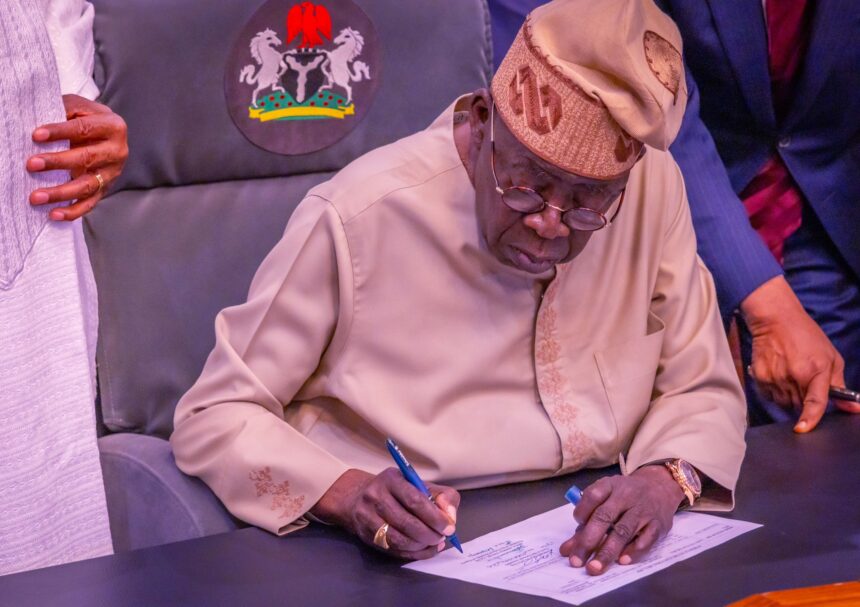
President Bola Ahmed Tinubu has officially signed the 2026 budget, authorizing an aggregate expenditure of ₦68.32trn for the 2026 fiscal year.
In a simultaneous move to ensure fiscal continuity, the President also signed the 2025 Budget Extension Bill, shifting the implementation deadline for the 2025 capital component from March 31 to June 30, 2026.
Tinubu signed the ₦68.32trn budget of 2026 during a signing ceremony that took place at the State House on Friday.
This was also contained in a statement issued by Bayo Onanuga, Special Adviser to the President on Information and Strategy.
The statement reads: “President Bola Ahmed Tinubu has assented to the 2026 Appropriation Bill, which provides for an aggregate expenditure of ₦68.32 trillion. He has also signed the bill extending the implementation period for the 2025 budget from March 31, 2026, to June 30, 2026.
“The N68.32 trillion budget for this year earmarks N4.799 trillion for statutory transfers and N15.8 trillion for debt service.
“It allocates N15.4 trillion to recurrent expenditure and N32.2 trillion to the Development Fund for Capital Expenditure.
“With capital expenditure accounting for about 50 per cent, the 2026 budget underscores the administration’s continued commitment to economic stability, national security, infrastructure development, and inclusive growth.
“The allocations reflect a strategic balance between statutory obligations, debt servicing, recurrent expenditure, and capital investments critical to driving productivity and improving the quality of life for Nigerians.
“Additionally, the President has assented to the Appropriation (Repeal and Enactment) (Amendment) Bill, 2026, which extends the implementation period of the capital component of the 2025 Appropriation Act from March 31, 2026, to June 30, 2026.
“The extension will ensure the full and effective utilisation of appropriated funds, particularly for critical infrastructure and development projects that are at advanced stages of implementation across the country.
“It will enable Ministries, Departments, and Agencies (MDAs) to consolidate ongoing works, enhance project completion rates, and maximise value for public expenditure.
“With the 2026 Appropriation Act coming into force on April 1, the Federal Government will commence full implementation in line with the Renewed Hope Agenda.
“President Tinubu directed MDAs to ensure disciplined, transparent, and efficient utilisation of allocated resources, with a strong emphasis on value for money and timely project delivery.
“He commended the leadership and members of the National Assembly for their diligence, cooperation, and patriotism in expeditiously considering and passing the budget.
“The President reaffirmed the importance of sustained collaboration between the Executive and Legislative arms of government in advancing national development objectives.
“He further assured Nigerians of his administration’s resolve to deepen fiscal reforms, enhance revenue generation, and prioritise investments that will stimulate economic growth, create jobs, and strengthen social protection mechanisms.”
Breakdown of the 2026 “Budget of Consolidation”
The 2026 budget, titled the “Budget of Consolidation, Renewed Resilience, and Shared Prosperity,” saw an upward review by the National Assembly from the initial ₦58.18 trillion proposal to ₦68.32 trillion.
This adjustment was made to accommodate legacy capital projects and critical interventions in the health and transport sectors.
Below are some key fiscal allocations:
- Capital Expenditure: ₦32.20 Trillion
- Debt Servicing: ₦15.80 Trillion
- Recurrent Expenditure: ₦15.40 Trillion
- Statutory Transfers: ₦4.79 Trillion
2025 Budget Extension: Why the June Deadline?
The President’s assent to the Appropriation (Repeal and Enactment) (Amendment) Bill, 2026, provides a three-month window for Ministries, Departments, and Agencies (MDAs) to exhaust funds allocated for 2025 capital projects.
The presidency said the extension aims to:
Prevent Project Abandonment: Ensure that critical infrastructure projects at advanced stages are not halted due to the expiration of the fiscal year.
Maximize Fund Utilization: Allow MDAs to complete procurement processes and payments for works already executed.
Ensure Accountability: Avoid the “rush-to-spend” culture that often leads to waste at the end of a fiscal cycle.