
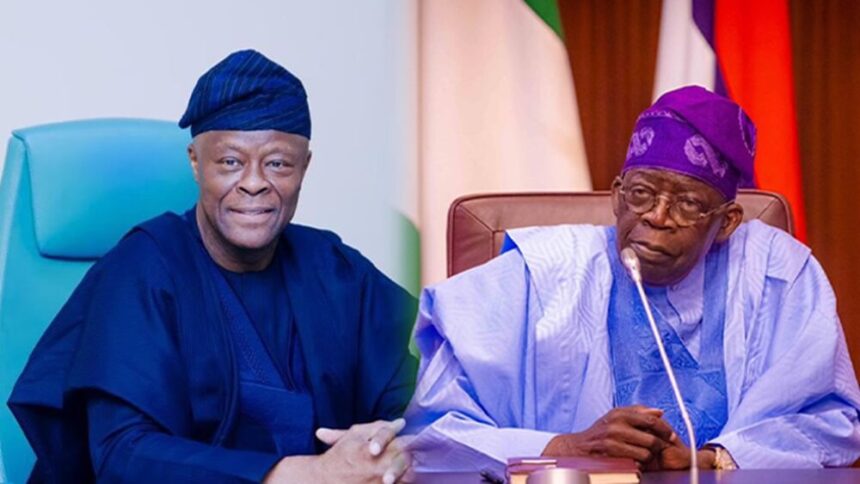
The era of Wale Edun as Nigeria’s Minister of Finance and Coordinating Minister of the Economy has officially come to an end on Tuesday, April 21, 2025.
This comes after President Bola Tinubu announced a cabinet reshuffle on Tuesday, relieving Wale Edun of his duties, marking the end of a 32-month tenure.
While the government has publicly characterized the move as a routine effort to strengthen institutional cohesion, reports emerging on Wednesday point to an alleged deepening rift between Edun and Tinubu.
It was gathered that the alleged rift was over fiscal priorities, specifically the funding of flagship infrastructure projects.
At the core of the alleged friction that ultimately saw the end of Edun under Tinubu’s administration was a fundamental disagreement regarding the management of federal revenue.
According to reports, tensions escalated significantly over the release of funds for two of the administration’s most prized infrastructure projects: the Lagos-Calabar Coastal Road and the Sokoto-Badagry Super Highway.
Both projects are managed by Hitech Construction (Nig) Ltd, a firm under the Chagoury Group. Sources indicate that Edun frequently advocated for a cautious approach, prioritizing the servicing of national debt, payment of salaries, and pension obligations over new, massive capital outlays.
Also, it was reported that Edun’s argument that there was insufficient fiscal headroom to prioritize these mega-projects reportedly placed him at odds with the administration’s drive for rapid infrastructure development.
“The president asked Edun to leave honourably in October last year but he lobbied to keep his position,” an insider told the press. “Although he stayed back, the president told his aides: ‘As far as I am concerned, I have done send-off for Wale already.’ But for some reason, Edun managed to hang on.”
Also, it was reported in September 2025 that Tinubu hosted the founding members of the defunct Congress for Progressive Change (CPC) and the Buhari Organisation who were on a solidarity visit to him at the presidential villa.
He told them that the federal government had met its revenue target for the year by August and this was widely reported.
However, Edun appeared to have contradicted Tinubu three months later while appearing before the House of Representatives committees on finance and national planning during an interactive session on the 2026-2028 medium-term expenditure framework (MTEF) and fiscal strategy paper (FSP).
He said the federal government projected a revenue of N40.8 trillion for 2025 to fund the budget but “current performance” suggested it would likely end at about N10.7 trillion — meaning a shortfall of N30 trillion.
Previously, the CBN would have printed money to finance some of the shortfall, although the resultant inflation did extensive damage to the economy.
“The president was unhappy that Edun publicly contradicted him,” another insider told TheCable.
Edun was also said to have talked back at the president in the presence of other ministers at a cabinet meeting late last year.
“For someone who was already walking on eggshells, this was a lot,” the insider added.
In October last year, reports surfaced online that Edun was seriously ill and had been flown abroad for emergency care, with Tinubu said to be shopping for his replacement.
Shortly after, the president’s media office announced that Edun was “indisposed” and would not be leading Nigeria’s team to the IMF/World Bank meetings.
However, Edun attended the Contemporary African Art Fair in London which coincided with the IMF/World Bank meetings, and the pictures were widely shared in the media.
He also returned to Abuja shortly after, attending public functions and giving speeches.
This was seen as a subtle rebuttal of the claim that he was “indisposed”.
In 1999, Tinubu appointed Wale Edun as commissioner for finance when he was governor of Lagos.
Edun resigned in February 2004, citing health grounds.