
As the countdown to the 2027 general elections intensifies, certain political developments are already shaping Nigeria’s economy.
Many analysts and economic experts have noted that the 2026 fiscal year is crucial for the administration of President Bola Tinubu in implementing its reform agenda.
From sweeping tax changes to insecurity and global headwinds, the next 18 months will test Nigeria’s ability to maintain fiscal discipline while navigating intense political manoeuvring.
Below are some political developments shaping Nigeria’s economy ahead of the next general elections;
Implementation of 2025/2026 Tax Reforms
The rollout of the Nigeria Tax Act 2025 and accompanying 2025/2026 tax reforms stands as one of the most consequential political developments shaping Nigeria’s economy ahead of the 2027 polls.
Effective January 2026, the new regime introduces automated compliance anchored on National Identity Number (NIN) linkage and corporate financial records. Eligibility for public office and contracts now tilts heavily toward verifiable financial transparency rather than mere documentation.
Key changes include a revised VAT derivation formula that favours high-consumption states, a reduction in multiple levies and overlapping taxes, and the introduction of new development levies. Tariff adjustments are deliberately structured to protect and promote local production. These measures aim to broaden the revenue base, eliminate distortions, and generate more non-oil revenue for infrastructure and social spending.
Economically, successful implementation could significantly increase government revenue and support macroeconomic stability. However, the political dimension is equally critical.
The new Electoral Act 2026 combined with the Nigeria Tax Act 2025 is forcing automatic, data-driven tax compliance for candidates.
Integrated NIN-linked databases may disqualify several aspirants who fail tax compliance thresholds, potentially reshaping the pool of 2027 candidates and triggering legal battles.
2026 Budget of Consolidation and INEC Appropriations for 2027
The 2026 Budget of Consolidation represents the government’s attempt to lock in gains from 2023–2025 reforms before the full weight of election spending hits.
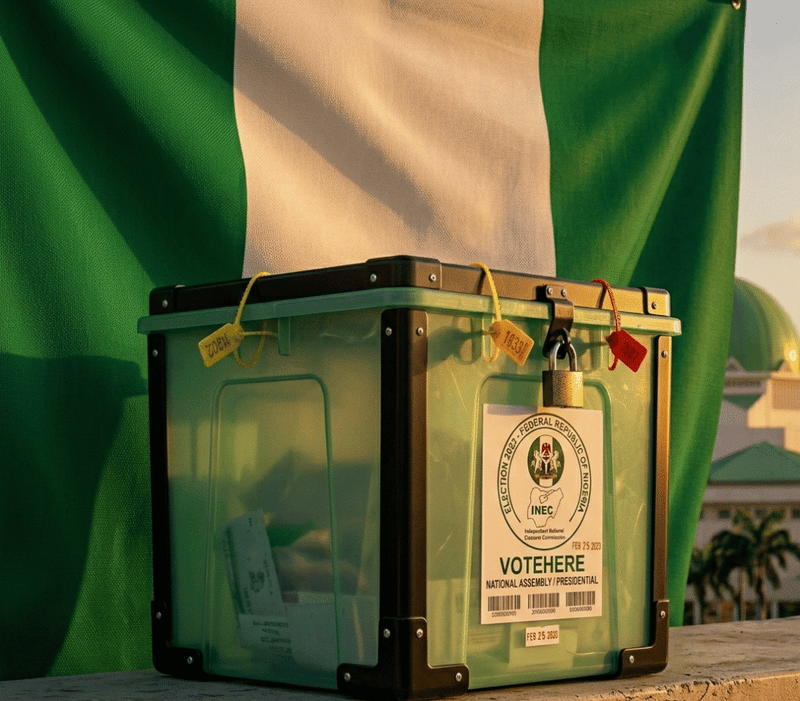
The 2027 elections are projected to cost over ₦873 billion, increasing government expenditure and threatening to reverse gains in inflation control.
Expected to emphasise fiscal prudence, infrastructure continuity, and revenue diversification, the budget must simultaneously accommodate rising demands for INEC funding and election-related expenditures.
Adequate and timely funding is essential for biometric upgrades, voter register cleaning, and logistical preparedness for the 2027 polls. Yet analysts fear that election-year politics could force supplementary budgets, ballooning deficit spending, and put pressure on the naira and inflation targets.
External Factors Intersecting with Domestic Politics
Already, global political developments have begun shaping Nigeria’s economy. The instability in the Middle East has skyrocketed fuel prices in Nigeria due to global oil price volatility.
Nigerians have begun to buy fuel for ₦1400 across the country. This has in turn, spiked the inflation rate for March for the first time in 10 months.
Also, the Middle East tensions have been boosting Nigeria’s foreign reserves and government revenue, providing a buffer for election spending.
Early Campaign Mode and Politics Over Policy
Nigeria has effectively entered early campaign mode, with elite bargaining, cross-party defections (particularly toward the ruling APC), and premature politicking dominating headlines. This “politics over policy” dynamic is perhaps the most immediate risk among the political developments shaping Nigeria’s economy ahead of the 2027 polls.
The Central Bank of Nigeria (CBN) has also warned that significant liquidity remains in the system. The historical tendency for increased government spending during election periods poses a direct threat to price stability. Managing this liquidity without stoking inflation is a primary concern for monetary authorities throughout 2026.
Insecurity as a Drag on Economic Activity and Voter Turnout
Persistent banditry, insurgency in the North-East, and farmer-herder conflicts across the Middle Belt continue to undermine both economic recovery and electoral credibility.
Insecurity directly constrains agriculture (which employs the majority of Nigerians), mining, and manufacturing in affected regions. It raises operational costs for businesses, deters investors, and forces the government to allocate larger portions of the budget to security, crowding out critical infrastructure and human capital spending.
On the electoral front, insecurity threatens voter turnout, complicates INEC logistics, and inflates campaign and security costs.
Low turnout in conflict-prone areas could raise questions about the legitimacy of results and further polarise the political landscape. Investors remain wary of committing long-term capital when stability around the 2027 polls remains uncertain.
Addressing insecurity is therefore not only an economic imperative but a prerequisite for credible elections and sustained post-2027 growth.