

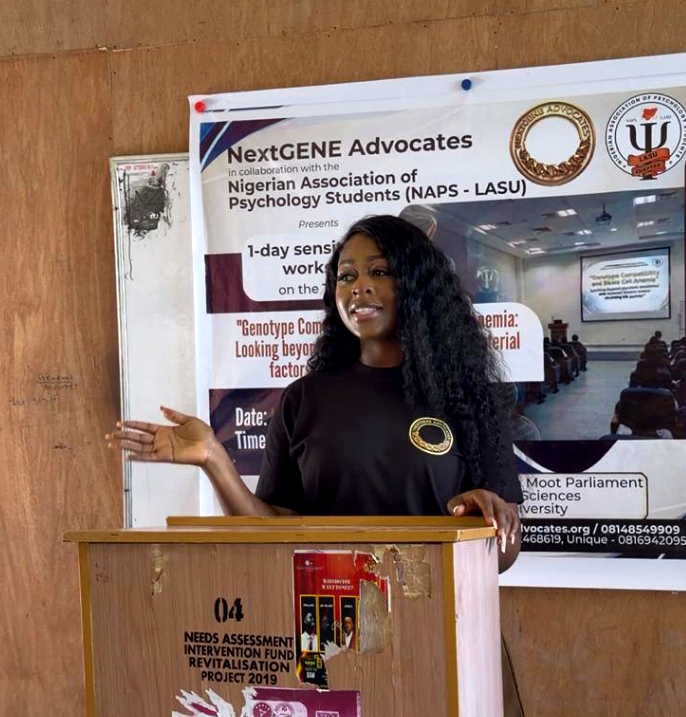
A growing concern over the rising burden of Sickle Cell Disorder (SCD) in the country has again brought genotype compatibility and informed relationship choices to the forefront, as medical experts, and advocates called on Nigerian Youths to look beyond emotions, appearances and financial considerations before choosing life partners.
The concerns formed the centrepiece of a one-day sensitisation workshop organised by NextGENE Advocate in partnership with National Association of Psychology Students (LAPS), Lagos State University Chapter.
The event was held Wednesday, May 20 at the Faculty of Social Sciences, Lagos State University,with the theme: “Genotype Compatibility and Sickle Cell Anemia: Looking beyond physical, emotional, and material factors before choosing life partner.”
The workshop drew students, healthcare advocates and academics who stressed the need for increased public awareness on genotype screening and premarital counselling.
Addressing participants, the Founder of NextGENE Advocate and convener of the programme, Miss Bisola Osundairo, cautioned young people against allowing emotions to overshadow critical health considerations when making marital decisions.
“The stats are griming. The excruciating pains that sickle cell patients and survivors go through is heartbreaking. The cost of maintaining them is totally out of pocket. We can’t continue to act ignorantly,” Osundairo said.
She maintained that many avoidable cases of sickle cell disorder persist because people refuse to confront genotype realities before marriage.
“It is high time we make informed decisions about choosing our life partners. Health status, genotype compatibility, among others, are priorities that we must not joke with henceforth,” she added.
According to the World Health Organization, Nigeria bears the highest global burden of Sickle Cell Disorder births, contributing nearly one-third of new SCD births recorded annually worldwide. Between 40 and 50 million Nigerians are carriers of the sickle cell trait, while an estimated four to six million Nigerians are currently living with the disorder.
Data from UNICEF further indicate that out of the estimated seven to eight million children born annually in Nigeria, about 150,000 are born with SCD.
Statistics also reveal that in several African countries, including Nigeria, between 50 and 90 per cent of children born with SCD may die before reaching the age of five, resulting in an estimated 100,000 or more child deaths annually.
Speaking during the workshop, Mr. Tayo Sekoni, a Psychology lecturer at LASU, said proper awareness and early preventive measures remain the most effective ways to reduce the prevalence of the disorder.
“This frightening reality can be prevented through adequate knowledge and informed decisions. Students and young adults must embrace premarital counselling, genotype screening, newborn testing, and public healthcare awareness campaigns such as this,” Sekoni told students.
Also speaking, Miss Modupe Adedayo, President of NAPS-LASU, accompanied by the Speaker of the students’ parliament, Francis Abiola, urged young people not to make relationship decisions solely based on physical attraction or social media influence.
“All that glitters are not gold. We must use the knowledge being passed here wisely and make informed decisions in choosing our life partners. We must not base everything off social media frenzies. Life is much more complex than that,” she said.
The event also featured presentations from Dr. Precious Pelumi Dasaolu, Founder of Your Pad Partner and keynote speaker, alongside Miss Anabaraonye Oluchi Mercy, who shared her lived experience as a sickle cell survivor.
In her presentation, Dasaolu described Sickle Cell Disease as an inherited blood disorder caused by abnormal haemoglobin that produces sickle-shaped blood cells.
She explained that the abnormal cells obstruct blood vessels, reduce oxygen circulation, damage organs and frequently destabilise the body system.
According to the medical doctor, many patients endure repeated episodes of severe pain medically referred to as Vaso-Occlusive Crises.
“The pain is triggered when the sickle cells become rigid and sticky due to blockage of blood flow in tiny blood vessels, thereby causing severe bone pain, chest pain, abdominal pain, joint pain, stroke risk, and organ damage,” she explained.
Dasaolu stressed that the consequences of genotype incompatibility extend beyond couples and directly affect unborn children.
“This is why the theme of this event — ‘Genotype Compatibility and Sickle Cell Anemia: Looking beyond physical, emotional and material factors before choosing life partner’ — is apt and very important. We must realise that our marital decisions carry weighty consequences for ourselves and our unborn children. That is why we must act wisely and make informed decisions,” she said.
She further noted that among the available genotype classifications, “AA genotype with positive Rhesus factor is the only healthy and safer blood type combination capable of producing healthy offspring without sickle cell disease.”
The emotional peak of the workshop came when Miss Anabaraonye narrated the physical, emotional and financial realities of living with SCD.
“Yes, I am a beautiful young lady. I have dreams and desires just like every one of you. But my condition — sickle cell disorder — has denied me the opportunity to live the kind of life I once hoped for,” she said tearfully.
She explained that although she enjoyed a normal childhood, her condition worsened two years ago when severe Vaso-Occlusive Crises began.
“You may say I look beautiful, and yes, I know that. But if I open my body for you to see, you will all cry for me,” she said.
According to her, years of repeated injections and medical procedures have left wounds, scars and painful skin damage across her body.
“I have open wounds all over me,” she added.
She explained that people living with SCD often have tiny veins, making injections difficult and painful, even though constant treatment is necessary to prevent severe crises.
Anabaraonye disclosed that she previously worked actively as a caterer before her condition forced her to stop working.
“In the last two years, my life has turned upside down. I have lost my business because I no longer have the strength and health to cater to clients. I have also lost my relationship.
“Nobody is willing to marry me because SCD is expensive to manage. You have to visit the hospital regularly, take injections, run tests, avoid certain foods, drink specific water, stay constantly in ventilated and air-conditioned environments, and still require emotional support.
“No man seems willing to take on all of that,” she said, leaving many students visibly emotional.