
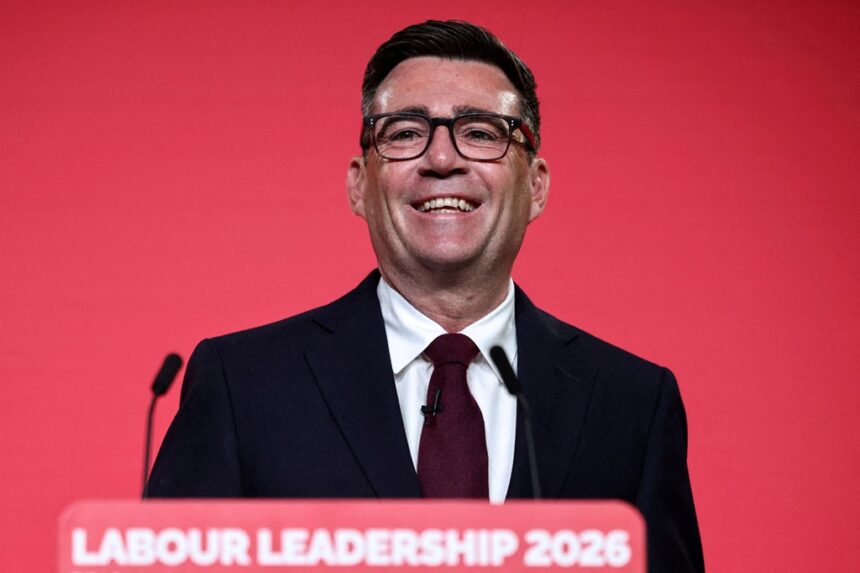
Andy Burnham has formally emerged as the new leader of the ruling Labour Party in the United Kingdom (UK).
Burnham, a former Mayor of Greater Manchester, ran uncontested, securing an overwhelming 379 out of 403 nominations from Labour MPs to emerge as the new leader of the ruling party in the UK.
Following the announcement by National Executive Committee (NEC) chair Shabana Mahmood, Burnham is now the UK’s Prime Minister-designate.
He is scheduled to officially succeed Keir Starmer on Monday, July 20, 2026, when he will visit King Charles III at Buckingham Palace to form a new government.
Addressing a special party conference in London, Burnham delivered a powerful acceptance speech detailing his vision for the country.
Burnham said he will be a pro-business Labour leader.
He said: “I will be a pro-business leader of the Labour Party as I was a pro-business mayor of Greater Manchester.
“We turned places round together, and that is the way we run in Manchester, and we will take it to the whole country.
“And as part of that, more power to reindustrialise and to build an education system based on parity between academic and technical education, to give every young person growing up in different parts of the country a path in life to university or to a work placement, to apprenticeship and into a good job.”
Burnham also declared that part of his commitments is about being a PM for all parts of Britain.
He added: “I will be a leader for the north, the south, the east and the west, for Scotland, Wales and for Northern Ireland.
“I am clear Britain took a series of wrong turns in the 1980s.
“Political power was centralised, and economic power was privatised.
“The country surrendered control of the essentials – housing, water, energy, transport -and left people exposed to higher costs.
“That in turn led to the concentration of more wealth and power in the hands of fewer people and fewer places.
“Large parts of Britain were industrialised without the power to set new ambitions for themselves.
“Proud British towns, now a shadow of what they once were, and high streets in decline, so common up and down the country.
“Slowly, at times imperceptibly, over four decades, political and economic power drained away out of our communities in every region and nation of the UK.
“If local places don’t control something as basic as a bus service, how can they connect people to opportunity and turn things around?
“If the sell-off of council homes leave country chasing rents in the private rented sector through the benefits system and paying for temporary accommodation for thousands of families, as they have to do here in London and elsewhere across the country, how then will we find the money to invest in prevention and improve people’s lives?”