
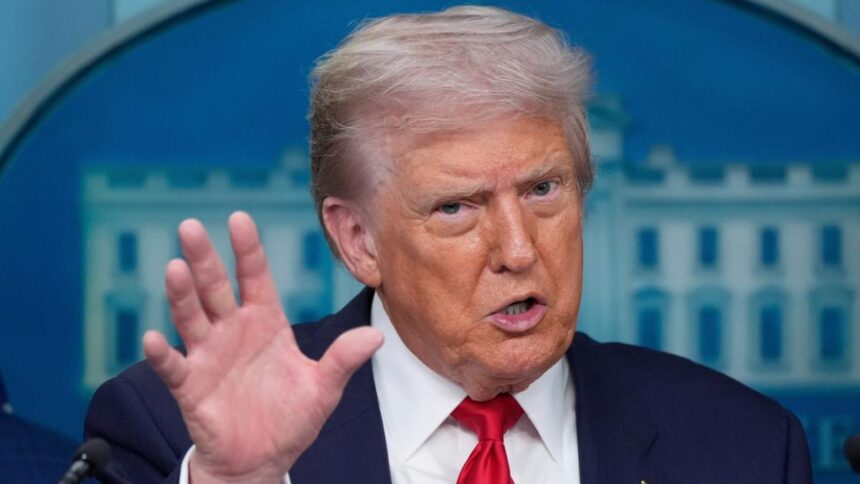
United States President Donald Trump’s new student visa rule could deal a crushing blow to the U.S economy, according to a recent report by the Peterson Institute for International Economics (PIIE).
The report comes as Trump’s new student visa rule caps international student visas at a rigid four-year limit, ending a decades-old policy.
The rule, issued in July and due to take effect in September, replaces the long-standing “duration of status” policy with a fixed stay of up to four years for most international students.
Economists warn that the move risks shrinking the nation’s high-tech workforce, slowing innovation, and costing the U.S. up to $400 billion per year in economic output.
According to the report, the new policy gives U.S authorities greater discretion over whether international students can extend their stay under the Optional Practical Training programme, which allows graduates to work in jobs related to their field of study.
The report warned that the change could significantly reduce the number of highly skilled international graduates entering the US workforce, particularly in science, technology, engineering and mathematics (STEM).
It noted that foreign STEM graduates educated in the United States make an outsized contribution to innovation and economic growth.
“US-trained foreign STEM graduates patent inventions at four times the rate of typical college graduates and establish high-growth startups at six times the rate of US-born graduates,” the report stated.
The institute estimated that if the United States experiences a sustained one-third decline in annual international student enrolment, the economic consequences would be substantial.
“PIIE estimates that if the US experiences a sustained one-third decline in annual international student enrolment, the economy could lose between $200 billion and $400 billion in output each year, equivalent to roughly 0.7% to 1.3% of GDP,” the report said.
The report also highlighted the importance of international education to the US economy, describing higher education as one of the country’s major export industries.
It noted that higher education accounts for about five per cent of US services exports and warned that a decline in international student numbers would reduce export earnings while slowing innovation, entrepreneurship and long-term productivity growth.
“The report also points out that higher education is an export industry for the United States, accounting for about 5% of US services exports,” it said.
The Peterson Institute argued that discouraging international students from choosing U.S universities could have lasting consequences for the country’s global competitiveness by reducing the pipeline of highly skilled talent that drives research, innovation and business creation.