

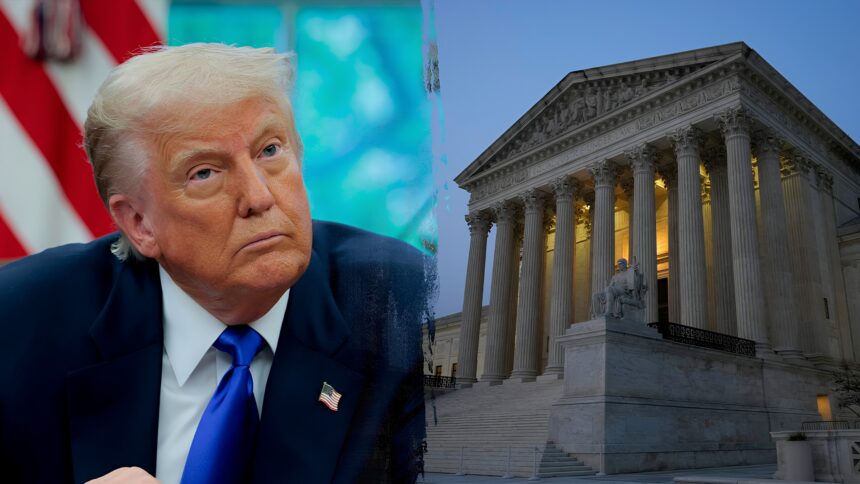
As the Supreme Court’s October 2026 term opens on Monday, October 5, immigration enforcement sits near the center of its docket.
A series of cases testing the U.S. President Donald Trump administration’s expanded deportation and detention policies could significantly alter the legal landscape during the Supreme Court’s new term.
The Court’s recent emergency interventions and grants of review signal a willingness to engage core questions of executive authority, due process, and statutory interpretation in immigration law.
The Third-Country Removal Case: DHS v. D.V.D.
The most immediately consequential matter as the Supreme Court’s new term opens is Department of Homeland Security v. D.V.D. (No. 26-426).
On September 29, 2026, the Court granted the government’s emergency application to stay a lower-court order blocking “third-country removals”, the practice of deporting noncitizens to countries other than their countries of origin or those designated in their removal orders, often nations with which they have no prior connection.
The Court simultaneously treated the application as a petition for certiorari, granted review, and scheduled oral argument for December 9, 2026. Justices Sotomayor, Kagan, and Jackson noted that they would have denied the stay.
Lower courts had required meaningful notice of the destination country and an opportunity for the individual to raise claims of fear of persecution or torture under the Immigration and Nationality Act (particularly 8 U.S.C. § 1231(b)), the Due Process Clause, and the Foreign Affairs Reform and Restructuring Act/Convention Against Torture implementing regulations.
The First Circuit largely upheld a Massachusetts district court’s finding that the government’s guidance was unlawful.
More than 25,000 people have already been removed under the policy since early 2025, with destinations including countries in Latin America and Africa (such as Burundi, Rwanda, and others that have agreed to accept deportees).
The questions presented include whether the district court had jurisdiction, whether it had authority to enter class-wide relief under 8 U.S.C. § 1252(f)(1), and whether the guidance is unlawful under statute, the Due Process Clause, or anti-torture protections.
The Court also invited the government to raise “such other questions that the Government determines are appropriate.” A ruling upholding broad executive discretion would expand the administration’s ability to remove people even when return to the home country is impractical or blocked, potentially accelerating removals.
A narrower decision reaffirming procedural protections could constrain the program and require individualized process before transfer.
Detention Without Bond: Mandatory Detention Policies
Parallel litigation addresses prolonged detention without bond hearings. The Court has granted review in Rhoney v. Barbosa da Cunha, which tests the administration’s interpretation of immigration statutes to require detention of noncitizens apprehended inside the United States (rather than at the border) without bond while removal proceedings continue. Lower courts have largely rejected the administration’s reading of the relevant provisions.
A related prolonged-detention issue returned via Genalo v. D.C. (No. 26-379), a petition for certiorari before judgment filed after the original vehicle (Genalo v. Black) became moot due to a state pardon. That case asks whether detention under 8 U.S.C. § 1226(c) can become “unreasonably prolonged” such that due process requires a bond hearing, and, if so, whether the government bears the burden of justifying continued detention by clear and convincing evidence. Immigration detention numbers have risen substantially (reports indicate around 70,000 people in custody, up from prior levels). Outcomes here will determine how long noncitizens, including long-term residents with U.S. ties, can be held without individualized review.
The case before the Supreme Court involves a Brazilian man, Ricardo Aparecido Barbosa da Cunha, who came to the U.S. illegally more than 20 years ago. Barbosa da Cunha has never been convicted of a crime, according to court papers. He applied for asylum in 2016 and was granted a valid work permit.
But last year, during a traffic stop in Massachusetts, Barbosa da Cunha was taken into custody by ICE officers, and the Department of Homeland Security initiated removal proceedings against him.
Barbosa da Cunha requested a bond hearing, but an immigration judge denied the request because he was subject to mandatory detention without the possibility of bond under a provision of federal immigration law.
He then filed a petition in federal court alleging that his detention without access to a bond hearing was illegal and a violation of the Constitution’s Due Process Clause. A federal judge sided with Barbosa da Cunha, and the U.S. Court of Appeals for the 2nd Circuit upheld that decision, rejecting the Trump administration’s mandatory detention policy.
In its decision, the 2nd Circuit panel of judges said accepting the administration’s interpretation of immigration law would “send a seismic shock through our immigration detention system and society, straining our already overcrowded detention infrastructure, incarcerating millions, separating families, and disrupting communities.”
Arguments in the case will likely be held early next year.