
A fresh diplomatic row has erupted between the High Commissioner of Nigeria to South Africa, Femi Fani-Kayode, and the South African Presidency following allegations that Nigeria’s delegation was deliberately excluded from the official livestream of a formal diplomatic ceremony in Pretoria.
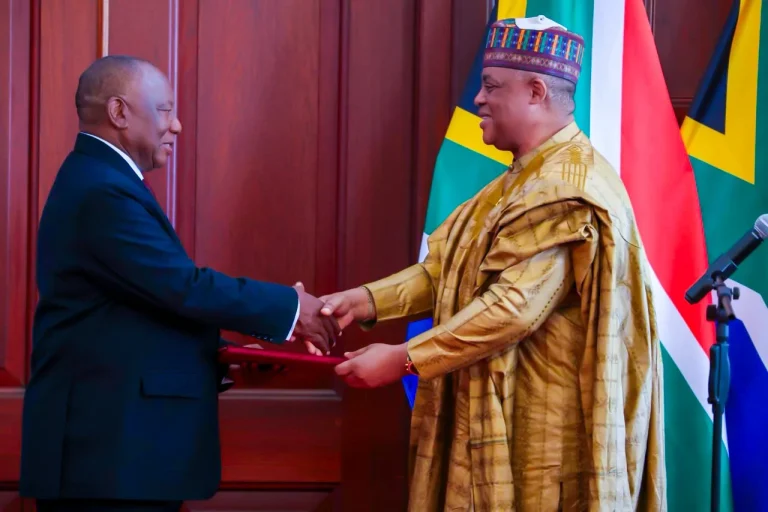
The controversy began on Thursday, November 13, 2026, at the South African Presidential Guest House, where Fani-Kayode joined 14 other envoys to formally present their letters of credence to South African President Cyril Ramaphosa.
While the proceedings were broadcast live, Fani-Kayode alleged that his formal introduction and address were conspicuously omitted from the stream, making Nigeria the only participating nation left out of the coverage.
In a post on his Facebook page on Friday, Fani-Kayode, a former Nigerian Minister of Aviation, condemned the omission as unacceptable treatment of Africa’s most populous nation.
In protest, Fani-Kayode disclosed that he declined an interview request from the South African Broadcasting Corporation (SABC), urging the broadcaster to instead listen to the speech that Presidency officials had failed to air.
According to Fani-Kayode’s account, he raised the issue directly with President Ramaphosa during a subsequent photo session.
He claimed that Ramaphosa personally accompanied him to question the officials responsible and directed them to resolve the matter immediately—an intervention Fani-Kayode thanked the president for, even though he noted it came too late to restore Nigeria’s segment to the live broadcast.
He said, “Every single one of the 15 ambassadors that were present was introduced formally and gave a speech.
“Curiously, the South African presidency refused to air the introduction of my good self and the Nigerian delegation or to air my speech. They went a step further by cutting us out of the livestream completely and went back on the livestream only after my speech was concluded.
“Of all the 15 introductions and speeches that were made and delivered this morning, only Nigeria’s was cut out.
“Right there in my presence, he questioned and directed them to resolve the issue immediately.
“Sadly, by then it was too late, and Nigeria had been left out. To be clear, I repeat, we were the only ones that were left out,” he added.
Fani-Kayode suggested that the incident might have resulted from a conspiracy by some individuals who did not want his speech broadcast.
He, however, said at least two Nigerian television stations were present at the event and had recorded his address, which would be released to the Nigerian public.
But the spokesperson for the South African President, Vincent Magwenya, faulted Fani-Kayode’s account, accusing him of misrepresenting Ramaphosa’s involvement in the matter.
In a response addressed to the Nigerian envoy on X, Magwenya said the South African President had neither intervened on his behalf nor interfered with the operations of the public broadcaster, the South African Broadcasting Corporation.
He said Ramaphosa merely directed Fani-Kayode to Sophie Mokoena, whom he described as the appropriate person to address his complaint.
“Your Excellency, you refused to speak to @Sophie_Mokoena, who would have cleared the misunderstanding with you. I would encourage you, that as you start your tenure in South Africa you meet with SABC to forge a mutually beneficial, respectful and professional relationship,” he said.
Magwenya maintained that the President had no legal or political mandate to interfere with the broadcaster’s operations or editorial processes.
He also described Fani-Kayode’s reaction to what he termed a minor operational issue as inappropriate, adding that the envoy should engage constructively with different aspects of South African society and its constitutional provisions.
“I wish you well on your tenure, and I hope you begin to engage the various aspects of South African society and its constitutional tenets constructively,” he added.
Pan-Atlantic Kompass reports that while Nigeria and South Africa share a deep historical bond forged during Nigeria’s heavy financial and diplomatic backing of the anti-apartheid movement, their post-1994 relationship has frequently been marked by political rivalry, immigration row, and economic friction.
Anti-immigrant demonstrations in South Africa and alleged killings of Nigerians have continued to escalate the diplomatic row between Nigeria and South Africa.