

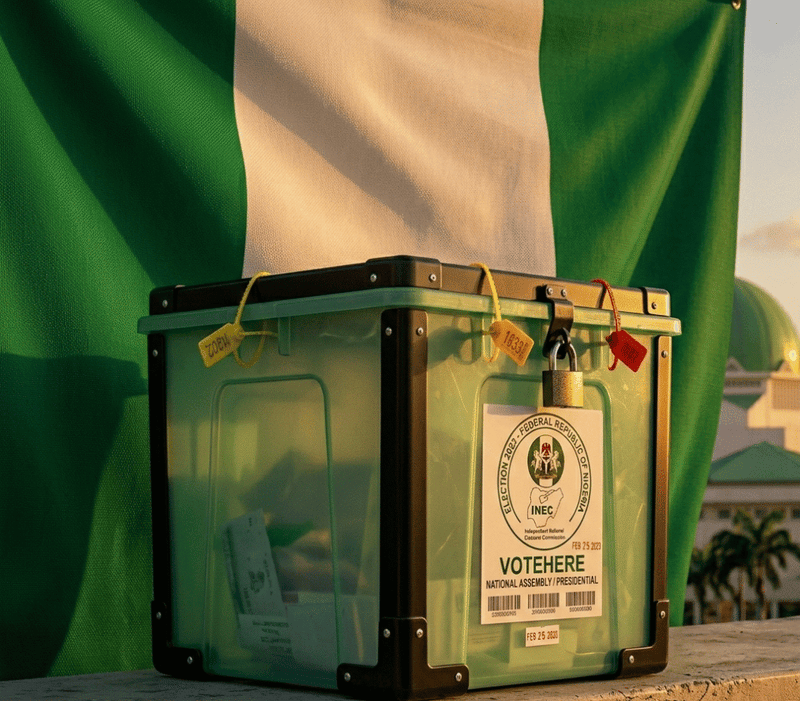
With just 51 days remaining until Nigeria’s 2027 general elections, a wave of Federal High Court rulings is scrambling candidate lists and creating fresh uncertainty for the Independent National Electoral Commission (INEC), political parties, and voters.
Presidential and National Assembly elections are scheduled for January 16, 2027, with governorship and state assembly polls on February 6. The statutory window for most candidate substitutions closed weeks ago ahead of the 2027 elections , yet courts continue to order INEC to add, remove, or restore candidate names on the ballot.
Recent Court Rulings Disrupting Senatorial Tickets
In one of the most recent decisions, a Federal High Court in Warri, Delta State, on November 24 nullified the nomination of former Deputy Senate President Ovie Omo-Agege as the Nigeria Democratic Congress (NDC) candidate for Delta Central Senatorial District. Justice Hyeladzira Nganjiwa ordered INEC to immediately remove his name from the candidate list and restrained him from presenting himself as the party’s nominee.
The court found that Omo-Agege’s name did not appear in the NDC membership register submitted to INEC at least 21 days before the primary, as required under the Electoral Act 2026. It also noted he had participated in the APC primary earlier, indicating he remained an APC member at the relevant time. Critically, the judge held that the statutory window for the NDC to conduct a fresh primary had already closed.
Days earlier, on November 18, Justice Inyang Ekwo of the Federal High Court in Abuja affirmed former Benue State Governor Gabriel Suswam as the valid All Progressives Congress (APC) candidate for Benue North-East. The court nullified the party’s substitution of Suswam with incumbent Senator Emmanuel Udende. Official INEC monitoring records showed Suswam won the May 18 primary with 131,083 votes to Udende’s 1,364. The judge ruled the substitution violated the Electoral Act, the Constitution, and the APC’s own rules, and directed the party to submit Suswam’s name to INEC.
The following day, another Federal High Court ruling (Justice M. Umar) upheld Erondu Uchenna Erondu Jnr as the authentic APC candidate for Abia South Senatorial District. It nullified the party’s attempt to replace him with Prince Paul Ikonne after Erondu had won the primary.
These cases join earlier disputes involving presidential and governorship tickets, including challenges around the African Democratic Congress (ADC) nomination process for Atiku Abubakar and exclusions linked to membership register compliance after a September 2026 Supreme Court ruling.
Why the Disruptions Keep Coming
Section 31 of the Electoral Act 2026 sets a 90-day window for certain substitutions, with October 18, 2026, as a key deadline tied to the January polls. Section 33 further restricts replacements mainly to death or voluntary withdrawal, requiring a fresh primary within 14 days in those cases. Yet courts continue intervening over alleged breaches of primary rules, membership registers, and fair hearing.
Former INEC National Commissioner Prof. Lai Olurode has defended the commission, arguing it is bound by party nominations and court decisions. “Where a court determines that a candidate whose name was initially submitted to INEC is not the authentic nominee… the commission is obligated to comply,” he said. He stressed that INEC cannot resolve internal party fights or ignore judicial orders.
Critics, including Ohanaeze Ndigbo chieftain Chief Goddy Uwazurike, question the timing and credibility of repeated late interventions. They warn that ongoing uncertainty risks eroding voter confidence so close to polling day. Other stakeholders, including former party officials and lawyers, largely blame political parties for irregular primaries, failure to follow membership register rules, and last-minute substitutions that invite litigation.
What This Means for the 2027 Elections
The successive rulings leave INEC under pressure to update lists while preparing logistics for tens of millions of voters. Some parties could face contests without candidates in affected constituencies if appeals or further judgments arrive too late. Voters may also struggle to know exactly who will appear on the ballot in certain races.
Campaigns are already underway in many areas. Late changes can disadvantage newly restored or substituted candidates and confuse supporters. Legal experts note that pre-election matters have strict timelines under the Constitution (generally 14 days to file, 180 days for trial, and 60 days for appeals), yet the compressed election calendar leaves little room for full appellate resolution before January 16.
As more cases wind through the courts, the final shape of many 2027 candidate lists remains fluid. INEC must continue balancing legal compliance with the practical demands of delivering credible elections on schedule. Political parties, for their part, face renewed scrutiny over how rigorously they conducted their primaries and managed internal disputes.
The coming weeks will test whether the remaining legal challenges can be resolved cleanly, or whether ballot chaos will cast a longer shadow over Nigeria’s next general elections.