
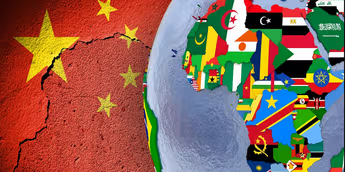
Multiple African nations accrued substantial Chinese debt obligations between 2000 and 2024.
This was also confirmed in new data from the Chinese Loans to Africa (CLA) Database.
According to the authoritative Chinese Loans to Africa (CLA) Database maintained by Boston University’s Global Development Policy Center, Chinese lenders committed approximately $180.87 billion across 1,319 loans to 49 African governments and seven regional entities over these 25 years.
These funds primarily supported sectors such as energy, transportation, and telecommunications, fueling roads, railways, power plants, and ports across the continent.
Below is the top 10 African Nations with the most Chinese Debt
Angola
Angola emerged on top of the list of African nations with the most Chinese debt having secured $49.2 billion across 271 separate loans. This massive portfolio, which accounts for roughly 27% of all Chinese lending to Africa, was primarily built on “oil-backed” loans used to rebuild the nation’s infrastructure following its civil war.
Ethiopia
Ethiopia follows as the second-largest borrower, with $14.0 billion in total commitments across 64 loans. Much of this capital fueled Ethiopia’s industrialization, including the landmark Addis Ababa–Djibouti Railway. In recent years, Ethiopia has been a primary candidate for debt restructuring under the G20 Common Framework to manage these significant obligations.
Kenya
Kenya holds the third spot, with $10.0 billion distributed over 62 loans. The most prominent symbol of this partnership is the Standard Gauge Railway (SGR). By 2024 and 2025, Kenya’s strategy shifted toward RMB-denominated loans to mitigate U.S dollar volatility, focusing on “small but beautiful” projects like rural road spot improvements.
Zambia
Zambia has accumulated $9.5 billion through 82 loans, primarily directed toward the mining and energy sectors. Zambia’s relationship with Chinese lenders has been a focal point of international finance after it became one of the first African nations to default during the pandemic era. As of early 2026, it continues to finalize long-term restructuring agreements with its Chinese creditors.
Nigeria
Nigeria has utilized $8.9 billion in Chinese credit, though notably with fewer individual agreements (25 loans) compared to its peers. Nigeria has focused its borrowing on high-impact transport projects, such as the Kano-Kaduna railway, seeking to modernize its aging rail network to support its status as Africa’s largest economy.
Egypt
Egypt ranks sixth with $7.7 billion across 19 loans. A significant portion of this funding has been channeled into the New Administrative Capital and various energy projects. Egypt’s recent engagement has focused on credit lines for small and medium enterprises (SMEs).
Sudan
Sudan has secured $6.3 billion via 66 loans over the past 24 years. Historically, much of this was tied to the development of Sudan’s oil industry and associated infrastructure. However, political instability and internal conflict in the mid-2020s have largely stalled new lending and complicated existing repayment schedules.
Cameroon
Cameroon has received $5.9 billion across 49 loans. These funds have been instrumental in developing deep-sea ports and hydroelectric dams. While the infrastructure has boosted capacity, analysts in 2026 note that Cameroon is increasingly seeking to balance its external relations with other emerging economies to manage its debt-to-GDP ratio.
Ghana
Ghana sits in the ninth position with $5.8 billion in total borrowing through 54 loans. Similar to Zambia, Ghana has faced severe debt distress in recent years, leading to a temporary freeze on new major Chinese projects while the government worked through domestic and external debt exchange programs to stabilize the Cedi.
Côte d’Ivoire
Côte d’Ivoire rounds out the top ten with $5.7 billion across 42 loans. The nation has used this capital to transform its energy grid and expand its port facilities in Abidjan. Interestingly, Côte d’Ivoire has maintained a relatively high credit rating, using Chinese loans as a strategic supplement to its diverse international borrowing portfolio.