

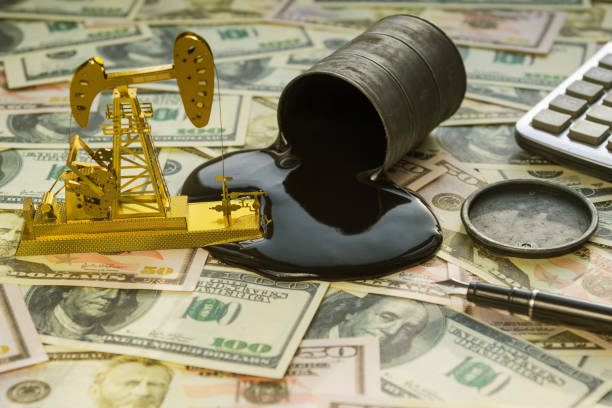
As the Middle East crisis continues to escalate following recent strikes involving the United States, Israel, and Iran, the global energy market has entered a period of volatility.
For Africa’s largest oil producer, the impact of rising oil prices on Nigeria has emerged on the front burner, with economists debating the paradox of fiscal windfall and domestic hardship.
As of press time, crude oil prices have surged, reaching $79 per barrel, the highest level in over a year and well above Nigeria’s 2026 budget benchmark of $64.85.
Brent crude, the global benchmark, climbed more than 9 percent to $79 per barrel, after touching an early trading high of $82. US West Texas Intermediate (WTI) also rose over 9 percent, trading at $73.06 per barrel.
The spike comes amid escalating geopolitical tensions in the Middle East. On Saturday, United States-Israeli strikes targeted Iranian sites, resulting in the deaths of Iran’s Supreme Leader Ayatollah Ali Khamenei, armed forces chief Abdolrahim Mousavi, and several close family members, including Khamenei’s daughter, grandchild, daughter-in-law, and son-in-law.
In retaliation, Iran launched multiple missile strikes across the region, raising fears of a broader conflict that could destabilize global energy markets.
The crisis has disrupted maritime traffic. Shipping giants, including Maersk, Mediterranean Shipping Company (MSC), and CMA CGM, have suspended sailings through the strategic Strait of Hormuz and the Suez Canal-Bab el-Mandeb corridor due to security threats. These routes are critical, carrying roughly 20 percent of the world’s seaborne oil and liquefied natural gas (LNG).
The impact of the surge in oil prices on Nigeria means more income for the government.
From a budgetary perspective, the current geopolitical instability is providing a much-needed injection of liquidity.
Nigeria’s 2026 budget was built on a conservative benchmark of $64.85 per barrel. However, with market prices now exceeding this, the federal government stands to see a substantial increase in the Federation Account Allocation Committee (FAAC) disbursements.
Increased export earnings are expected to bolster the Central Bank of Nigeria’s (CBN) external reserves, which experts project could reach $51 billion if production holds steady.
The influx of petrodollars provides the CBN with more ammunition to defend the Naira, potentially reducing the volatility that has plagued the currency over the last year.
In a report issued by the Centre for the Promotion of Private Enterprise (CPPE) on Monday, the organization stated that higher oil receipts typically ease pressure on the naira by boosting FX liquidity.
Part of the report reads: “Nigeria could benefit through higher export receipts, stronger reserves, and increased government allocations.
“Yet, production remains constrained at 1.4–1.6 million barrels per day, undermined by theft, vandalism, and underinvestment. Without tackling these bottlenecks, Nigeria risks missing out on the full windfall.”
Despite the gains in the national treasury, an average Nigerian will face a different reality of the impact of oil prices in Nigeria.
With the full removal of the fuel subsidy, domestic petrol prices are now directly tethered to the international market.
Analysts warn that if crude stays above $100 per barrel, petrol prices in Nigeria could rally to ₦1,200 per litre.
Since Nigeria still relies heavily on imported refined products and expensive logistics, the surge in energy costs is expected to spill over into food prices and manufacturing overheads.
CPPE added: “Domestic welfare risks loom large. With deregulated fuel pricing, higher international crude costs translate directly into rising petrol, diesel, and aviation fuel prices. This feeds into transportation, food distribution, and manufacturing costs, intensifying inflationary pressures.
“While government revenues may rise, household welfare could deteriorate—creating a divergence between fiscal gains and social outcomes.”
Pan-Atlantic Kompass reports that already the Dangote Petroleum Refinery has increased its Premium Motor Spirit gantry price by N101, raising the ex-depot rate from N774 to N875 per litre.
A senior official at the refinery confirmed the development to the press, noting that the adjustment followed recent volatility in global crude oil prices.
“Yes, the price has been reviewed. The new gantry price is now N875 per litre from N774. The review became necessary due to changes in global crude fundamentals and replacement costs,” the official said.
Speaking on the development, a renowned professor of petroleum economics, Prof. Wumi Iledare, advised that Nigeria must resist the temptation to interpret the U.S.–Iran strike as the beginning of another historic oil shock.
He said: “In the past, prices reacted sharply because supply options were limited and market information was slower. Today, markets operate on rational expectations. Traders and investors assess real-time data — spare capacity, alternative supply sources, demand conditions, and the probability of sustained disruption.
“Unless there is a prolonged and material loss of physical supply, any price spike is unlikely to be permanent. OPEC does not set oil prices. Prices are determined in global markets. Geopolitical tensions may introduce a temporary premium, but that premium fades when fundamentals remain stable.”
He added that for Nigeria, this is where caution is essential, and if crude prices move toward $80 per barrel, it should not be treated as a new normal.
Pan-Atlantic Kompass also reports that while higher oil prices are positive in reducing budget deficits and borrowing, Nigeria has committed significant volumes of its future crude oil production to forward sale agreements with various entities.
Since 2018, the NNPC has executed multiple crude sale agreements totalling $21.56 billion in 11 deals, including Project Leopard and Project Gazelle II. While these projects brought instant liquidity to Nigeria, they committed future production to be supplied to lenders.
In 2025, it was reported that forward crude sales by the Nigerian National Petroleum Company Limited (NNPC) hit $21.565 billion since 2019.
While there are no reports on the quantity of crude oil that has been mortgaged, information showed that 11 deals have been entered into by the NNPC since 2019.
Aside from the vendor programmes of $750 million and $1.5 billion, which expired in May 2023 and November 2024, respectively, the final maturity dates for the nine other projects continue to run.
Other extant facilities which have yet to reach maturity include: The $3 billion deal on NLNG Train 7, which matures in May 2029; the $1 billion ‘Project Eagle’ agreement, which expires in June 2025, and the $300 million ‘Project Brogue’, which has a final maturity of January 2027.
Besides, ‘Project Bison’, which was entered into in 2021 worth $1.040 billion and expires in December 2026; ‘Project Yield’, which was sealed in 2022, is valued at $1 billion and expires in June 2029; while a project codenamed ‘Offtake Financing’ costing $75 million expires in October 2029.
Furthermore, ‘Project Gazelle’, an oil swap deal valued at $3.4 billion, is expected to expire in 2032.
This means the Domestic Crude Supply Obligation agreement cannot be fully implemented for Nigerian refiners like Dangote. The implication is that the NNPC will have to deliver crude at higher prices to other entities rather than prioritizing local refiners.