
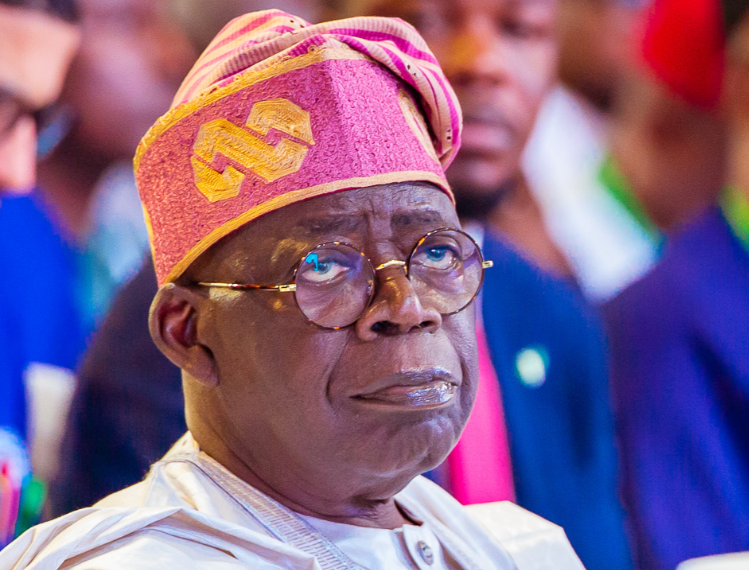
Indications have emerged on Wednesday, March 11, 2026, that the government of India has reportedly rejected President Bola Tinubu’s ambassador pick for the country.
It was gathered that India reportedly hinged its decision to reject Tinubu’s ambassador pick on its diplomatic policies.
Pan-Atlantic Kompass had reported that Tinubu designated Ambassador Muhammad Dahiru, a career diplomat to lead Nigeria’s mission in India. Dahiru was part of the total of 65 ambassador-designates approved for posting by Tinubu on March 6, 2026.
However, sources within the Presidency confirmed to the press on Wednesday that India has reportedly indicated its decision to decline granting agrément, a formal diplomatic consent, because the Tinubu administration is approaching its final year before the next general election cycle.
Recall that the Independent National Electoral Commission (INEC) recently announced that the presidential election has been for January 16, 2027. Also, Tinubu’s first tenure is set to conclude in May 2027.
Under the 1961 Vienna Convention on Diplomatic Relations, host countries reserve the right to vet and approve any incoming head of mission.
It was gathered that India has a policy which is aimed at ensuring that diplomatic representatives have sufficient time to build meaningful, long-term bilateral programs.
While the Senate confirmed 65 nominees in December 2025, the actual posting orders were only finalized in March 2026.
This delay was said to have left several envoys facing the prospect of being “dead on arrival” in countries that share India’s strict tenure requirements.
One of the presidential sources was quoted as saying: “They don’t accept an ambassador from an administration that has less than two years in office. So they are giving us that body language already.
“Some countries are reluctant to accept some people, not because of the individuals but because of the time. They are already seeing the Tinubu government as an outgoing government.
“So their concern is that he has just one year left, so what if he doesn’t win the election? Another government may come and remove them. We also understand that some countries have this policy. Any ambassador from an administration that has less than a year or two in office will not get accepted. And one of such countries is India.”
A second source, a senior foreign service official, confirmed India’s position but expressed hope that Nigeria could leverage its relationship with New Delhi to secure an exception.
“I know India has that policy. If you are less than two years from the end of your tenure, there will be difficulties accepting an ambassador. Maybe we can leverage our relationship with them to scale through that.
“Of course, there are those among them who gauge political tides, and some may see that this government can win the next election. Perhaps they may see that the election may not be so competitive because virtually everybody has moved towards the APC. They may say the chances for the APC’s victory are high. That is one of the arguments the government will push forward.
“India is the only one I can confirm to you for now. The others will be based on their conventions and practices. But the one I know for sure now is India. We will have to do a lot of convincing because they have a standing rule.”
It was gathered that as of press time, the Ministry of Foreign Affairs has so far only received agrément from the United Kingdom for High Commissioner-designate Aminu Dalhatu and from France for Amb Ayodele Oke, leaving the fate of the remaining 63 envoys uncertain.
Recall also that Pan-Atlantic Kompass had reported that the administration of Tinubu is struggling to secure agrément for the new ambassadors-designate.
A political scientist, Kunle Fagbemi had revealed that the prolonged absence of full-rank ambassadors is one of the reasons Nigeria has been unable to secure an agrément for new diplomats.
He pointed out that since the mass recall of envoys in September 2023, missions have been led by chargés d’affaires, who often lack the high-level access required for international diplomacy.
He said: “This is a confirmation of the challenges that we have been facing with the incumbent APC-led administration under President Bola Ahmed Tinubu. They are operating a very dysfunctional presidency and diplomatic service.
“Like you rightly said, every elementary student of diplomatic practice, or diplomacy, or foreign affairs understands that the Vienna Convention is very explicit on what ought to be.
“Article Three talks about the fact that you should have a mission. Article four talks about the agrément that we’re all making reference to, which automatically means that if you have a mission in any country, you want to maintain the operations of that mission at the highest level possible for correct interface.
“So, when in September 2023 President Tinubu decided to recall all these ambassadors back, if a number of the officials in the ministry of foreign affairs were very conversant with the provisions of the Vienna Convention on Diplomatic Relations and some of the protocol instruments there from and thereto, they would have understood that you must make sure that within the maximum of 90 days, you need to have appointed another ambassador, as it were, or appoint a special envoy that will cover the jurisdiction.
“Unfortunately, all of us are very aware of the facts in the public domain. Nothing was done between September 2023, and Q3 of 2025, when we started having a list of the first four names, and then you had another additional list that was sent to the National Assembly.”