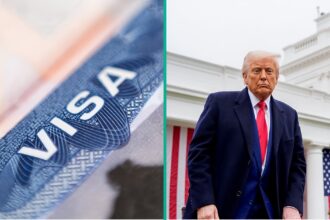

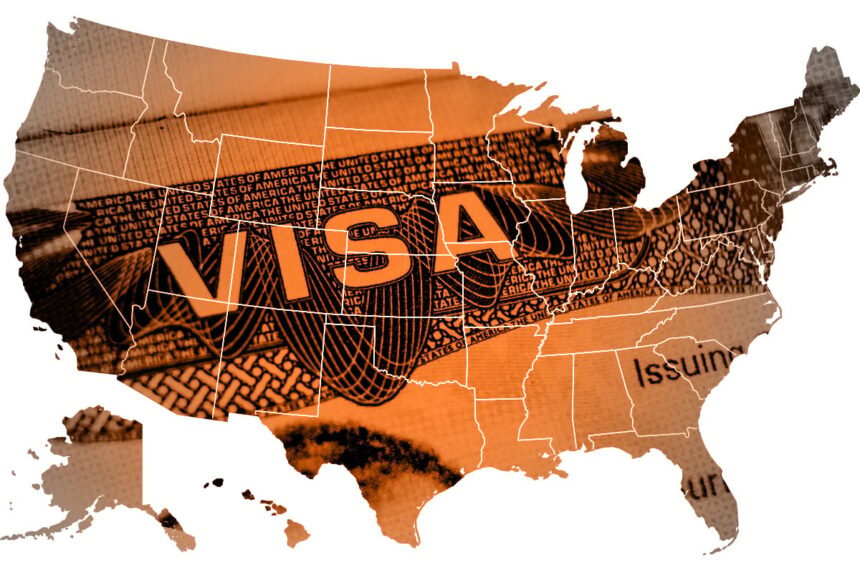
Recent data published by the United States (U.S) Department of State has revealed that Nigeria saw a 52% drop in student visa issuances in the summer of 2025.
This means that the issuances for F-1 student visas for Nigerians fell by 52% during the summer months of 2025 compared to the previous year.
Pan-Atlantic Kompass reports that the F-1 visa, the primary nonimmigrant visa for academic students, allows individuals to pursue full-time study at accredited institutions.
This sharp decline, covering the peak period from May to August when many prospective students secure visas for fall enrollment, has raised alarms among Nigerian students, U.S universities, and education stakeholders about access to American higher education.
According to analyses of monthly nonimmigrant visa issuance statistics on the official website of the U.S Department of State, overall F-1 visa grants plummeted by 36% year-over-year during the summer season.
Nigeria, a key source market for international students, ranking among the top senders from Africa, experienced one of the steepest reductions alongside countries like India (62% drop) and Nepal (72% drop).
Further breakdown revealed that across these three months, consulates issued 186,160 student visas, down from 289,752 in 2024. This is a drop of more than 100,000 visas during the period when most international students secure approval for fall enrollment.
The decline was most pronounced in June, when visa issuances dropped 50% year-over-year. This sharp decrease aligns closely with the pause in visa processing. July remained down 35% compared with 2024, but showed partial recovery as consulates gradually resumed operations and worked through backlogs. By August, issuance levels were only 7% below the previous year, suggesting that some visa processing shifted later into the summer.
Pan-Atlantic Kompass checks revealed that this data that showed that Nigeria saw a 52% drop in student visa issuances aligned with the numerous visa policies that have been implemented by the administration U.S President Donald Trump.
Recall that the U.S government revised its visa policy for Nigerian nationals, introducing more restrictive terms for most non-immigrant, non-diplomatic visas in July.
This means that Nigerian visa applicants are only eligible for single-entry visas valid for just three months.
The U.S government had explained that the policy was in line with the visa reciprocity arrangement.
Also, in August 2025, the United States mandated that Nigerians submit a list of all social media usernames they used over the past five years.
Recall also that on May 27, 2025, the U.S government suspended the scheduling of U.S. student visa interviews globally, including in Nigeria.
The policy, directed by U.S. Secretary of State Marco Rubio, is part of a broader immigration and higher education crackdown under the Trump administration.
The suspension lasted for about a month before it was restored on June 19, 2025.
Further breakdown revealed that India, the U.S’s largest sending market, saw visa issuance plummet by 62%, with just over 22,000 F-1 visas issued to Indian students across the summer.
Other top sending countries, China (-35%), South Korea (-21%) and Vietnam (-25%), saw notable but more modest declines. And while Canada is the third-largest source market for the U.S, students do not need visas to study in the U.S so are not included in the data.
Reacting to the data, Bill Colvin, Shorelight senior vice president, global solutions, said: “The June collapse was largely mechanical, but students and families were already reassessing the US well before that, with visa revocations, social media screening, and real uncertainty around OPT all feeding into their decision-making.”
Also, a Boston College professor Chris Glass, said: “The pause took a soft enrolment cycle and turned it into a severe contraction,” warning that underlying structural constraints did not disappear when interviews resumed.
Elsewhere, NAFSA’s warning of a 30-40% drop in new international enrolments has been proven accurate – a decline the association linked directly to policy changes “that have erected unnecessary barriers for qualified students”, said NAFSA CEO Fanta Aw.