

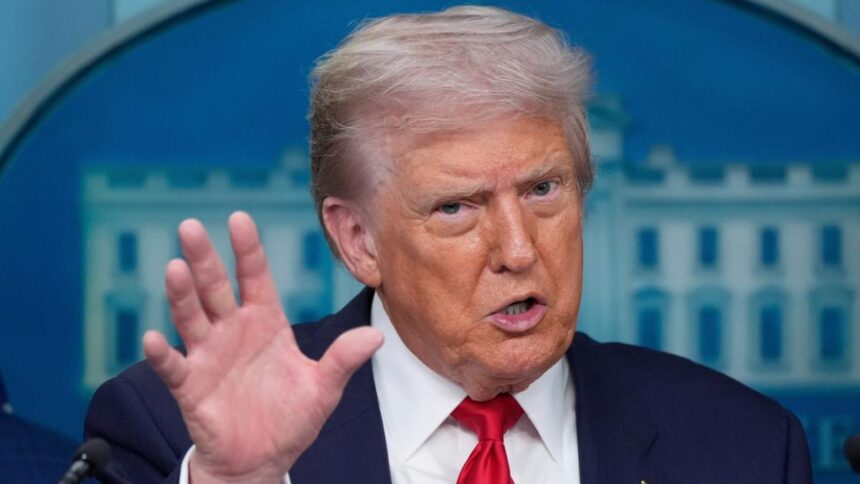
Global oil prices have begun to fall after United States President Donald Trump announced Monday that he has ordered a five-day postponement of planned military strikes against Iran’s energy sites.
As of early Monday, the price of Brent had hit $113 a barrel, but it fell shortly after Trump’s latest comments. It fell to a low of $96 a barrel, before rebounding to $103.
The decision to halt strikes on Iran’s energy sites comes after what the U.S President described as “very good and productive” peace negotiations aimed at resolving the conflict in the Middle East which has now entered its fourth week.
The White House had previously issued a 48-hour ultimatum, threatening to “obliterate” Iran’s power plants if the Strait of Hormuz—a vital artery for global oil—was not immediately reopened to international shipping.
However, as the deadline approached, Trump took to Truth Social to signal a temporary de-escalation, citing a significant change in the “tenor and tone” of recent diplomatic exchanges.
It was gathered that the pause is contingent on continued progress in the ongoing US-Iran peace negotiations.
While the Pentagon had reportedly finalized targets for a massive aerial campaign against Iran’s energy grid, the President has instructed the “Department of War” to hold all kinetic operations for at least 120 hours.
“Based on the tenor and tone” of the talks, “which will continue throughout the week, I have instructed the Department of War to postpone any military strikes against Iranian power plants and energy infrastructure for five days, subject to the success of the ongoing meetings,” Trump stated.
However, Iran has rejected Trump’s claim that Washington and Tehran have held discussions.
This was disclosed on Monday via the official X account of the Islamic Republic of Iran Broadcasting (IRIB).
Iran’s state media dismissed Trump’s claims, insisting that no communication has taken place between the two countries.
“No conversation has taken place between Iran and the US, and Trump’s claim about having these talks is false,” IRIB stated.
Meanwhile, the diplomatic pause comes against the backdrop of escalating conflict in the region. Hostilities, widely referred to as “Operation Epic Fury,” began on 28 February 2026, with a large-scale joint U.S-Israeli offensive targeting Iranian nuclear facilities, missile bases, and senior leadership.
The conflict has since intensified, with Iran launching retaliatory missile strikes on U.S military installations in the Gulf and on Israeli cities, while also disrupting global shipping by effectively closing the Strait of Hormuz. The disruption has driven oil prices above $126 per barrel and triggered volatility in global markets.
Humanitarian concerns have also mounted, with more than 2,000 deaths reported across Iran, Lebanon, and Israel.
More than 2,000 people have been killed across the Middle East as the war enters its fourth week. In Iran, Israeli and American strikes have killed more than 1,200 people, according to the Iranian Red Crescent Society. At least 1,000 people have been killed in Lebanon, and 15 have died in Israel. Thirteen U.S. service members have been killed, and two more died of noncombat causes.
Despite the temporary pause in planned strikes, tensions remain high. Iran has warned that any further attacks on its territory could result in the mining of the Persian Gulf, while Israel has continued military operations in Lebanon.