
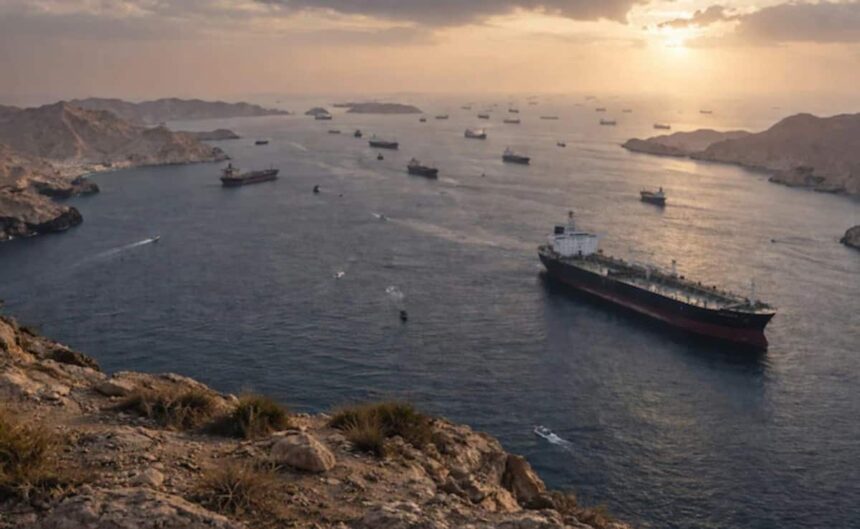
Iran announced on Friday that it has decided to open the Strait of Hormuz, restoring full commercial access to the world’s most critical chokepoint.
The Foreign Minister of Iran Abbas Araghchi confirmed the move to open the Strait of Hormuz, adding that the maritime security protocol has been updated to allow the “completely open” passage of all commercial vessels, a decision timed to coincide with a fragile 10-day ceasefire between Israel and Lebanon.
The announcement specifies that all merchant ships—including those carrying oil and liquefied natural gas (LNG)—may now transit the waterway using a coordinated route established by Iran’s Ports and Maritime Organization.
This marks the first significant easing of naval tensions since the conflict began on February 28, 2026, which had previously seen traffic through the passage grind to a virtual halt.
In a statement on X, Araghchi said: “In line with the ceasefire in Lebanon, the passage for all commercial vessels through [the] Strait of Hormuz is declared completely open for the remaining period of the ceasefire, on the coordinated route as already announced by Ports and Maritime Organisation of the Islamic Rep. of Iran.”
United States President Donald Trump has already reacted after Iran announced a move to open the Strait of Hormuz.
Trump who took to his Truth Social platform said that the Strait of Hormuz is “COMPLETELY OPEN AND READY FOR BUSINESS”.
He stated: “BUT THE NAVAL BLOCKADE WILL REMAIN IN FULL FORCE AND EFFECT AS IT PERTAINS TO IRAN, ONLY, UNTIL SUCH TIME AS OUR TRANSACTION WITH IRAN IS 100% COMPLETE.
“THIS PROCESS SHOULD GO VERY QUICKLY IN THAT MOST OF THE POINTS ARE ALREADY NEGOTIATED. THANK YOU FOR YOUR ATTENTION TO THIS MATTER! PRESIDENT DONALD J. TRUMP.”.
Meanwhile, oil prices have plummeted after Iran said the Strait of Hormuz would be “completely open” to commercial ships for the remainder of the ceasefire.
The cost of a barrel of Brent crude fell to 88 dollars a barrel, having been above $98 earlier on Friday.
Global markets also rallied on the announcement, with the major US stock indices rising in early trading. The S&P 500 rose by 0.8%, while the Nasdaq and Dow Jones Industrial Average (DJIA) were both up by more than 1%.
European shares also rose in reaction to the news. The Cac index in Paris and Dax in Frankfurt both climbed by more than 2%, while London’s FTSE 100 rose by around 0.5%.
The Strait of Hormuz has been effectively shut by Iran since the U.S and Israel launched military strikes in the country in late February.
Tankers have been unable to pass through, drastically reducing the amount of oil and gas available on global markets and causing prices to spike.
Before the conflict, Brent crude was trading at under $70 per barrel. It rose above $100 before reaching a peak of more than $119 per barrel in March.