
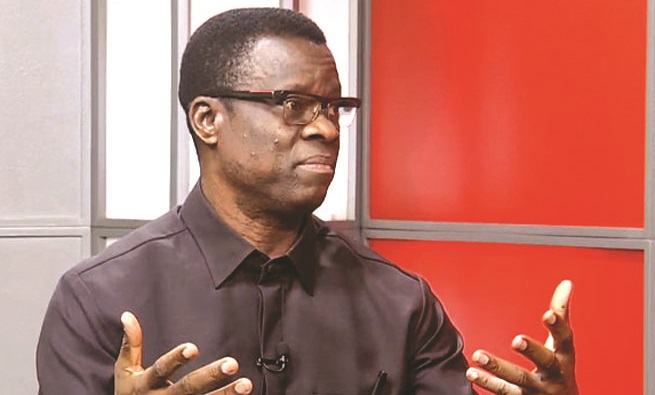
A former Resident Electoral Commissioner (REC) of the Independent National Electoral Commission (INEC), Mike Igini, has raised fresh concerns over the authorisation of the use of unmarked ballot papers for Nigerian elections.
Igini described the authorisation which was contained in the 2026 Electoral Act as a provision that could fundamentally undermine the credibility of future polls, including the highly anticipated 2027 general elections.
The former INEC official specifically highlighted the risk that the authorisation of unmarked ballot papers for elections could potentially open the door to electoral manipulation and subvert the sanctity of the vote.
Speaking on Arise TV’s The Morning Show and monitored by Pan-Atlantic Kompass on Wednesday, Igini pointed to Section 63 of the Act, alleging that it allows presiding officers to accept ballot papers that do not bear INEC’s official marks or security features, provided they are “satisfied” with their authenticity. He argued that this introduces subjective discretion that could be exploited.
A review of the 2026 Electoral Act shows that Section 63 reads thus;
1) Subject to subsection (2), a ballot paper which does not bear an official mark prescribed by the Commissioner shall not be counted.
2) Where the returning officer is satisfied that a ballot paper which does not bear the official mark was from a book of ballot papers which was furnished to the Presiding Officers of the polling unit in which the vote was cast for use at the election in question, he or she shall, notwithstanding the absence of the official mark, count the ballot paper.
According to him, the use of the word “satisfied” revives a controversial clause previously contained in the 2010 Electoral Act, which was later removed after years of criticism.
Igini warned that such discretion could enable the use of unmarked ballot papers during elections.
The ex-REC also raised concerns about Section 138, which deals with grounds for filing election petitions. Igini said the provision suggests that actions or omissions contrary to INEC directives—but not explicitly against the Electoral Act—cannot be used as grounds to challenge election results.
He argued that this effectively shields electoral officers who fail to comply with INEC guidelines, noting that such directives are typically contained in the commission’s regulations.
Furthermore, Igini criticised Section 137, which he said removes the requirement to join electoral officers—such as presiding or returning officers—as respondents in election petitions involving allegations of misconduct.
Section 137 reads thus;
Where the petitioner complains of the conduct of an electoral officer, a presiding officer, or a returning officer, it shall not be necessary to join such officers or persons notwithstanding the nature of the complaint and the Commission shall, in this instance, be
- a) made a respondent; and
- b) deemed to be defending the petition for itself and on behalf of its officers or such other persons.
He expressed concern that this provision could make it difficult to hold individual officials accountable for alleged irregularities during elections.
He said: “You know I said I have not been interested in so many things because I’m so disappointed, but I decided and said let me go through the Electoral Act.
“I found that whereas the last intervention we had here was discussing Section 60, sub-section 3, where the act provided a proviso that will undermine the 2027 official elections.
“I have now found three more dangerous provisions, and I put them out, and I think that Nigeria can read them.
“First, let’s go to Section 63. Now, Section 63, which I just discovered, has reintroduced something very terrible. You can see it there that the ballot paper that will be used for the 2027 election, which does not bear the official marks and features, and security features of INEC should be accepted by the presiding officer.
“The Presiding Officer has now been given a discretion to accept a ballot paper, notwithstanding the absence of the official mark, and to count that ballot paper.
“What that means is that before this election, politicians who now have access to the security features of the INEC ballot are going to produce their ballot papers. They are going to print their own ballot paper to be accepted. This is dangerous and they put it in the Electoral Act.
“Similarly, may I show Section 138, which has been one of the rigging provisions that we have cried out to be removed. As a matter of fact, you remember that in 2019, in this current Republic under Buhari, there was the only time that there was no Electoral Act passed. When we made that recommendation that this thing should be removed, this section should be removed, remember that it was rejected.
“It says that an act or omission which will be contrary to the instruction or directive of the commission, or of an officer appointed for election, but which is not contrary to the provision of this Act shall not, of itself be a ground for questioning the election.
“May I make a few observations here. You see, when you want to deceive people, you put it in words and bring that section back again. They were just short of referring to INEC regulations and guidelines, because the instructions and directives of INEC are contained in INEC regulations and guidelines.
“They are saying that a presiding officer, a coalition officer, a returning officer, they can abandon the INEC directive or regulation. So they provided immunity there.
“Let’s go to the last section. It will interest Nigerians to know that section 137
Now, I think that all those categories of individuals, I think the other time, I provided you with what we call a pyramid. All the categories that we have just mentioned, Presiding Officer and the Returning officers. It says that where the petition, that is where anybody now wants to file a petition, complaints of the conduct of an Electoral Officer, a presiding officer, returning officer, it shall not be necessary to join such officer. That means that those who have disobeyed the INEC instruction and guideline, that it shall not be necessary to bring them to the court.
“You are now saying that the people who rig elections, presiding officers, who actually were the makers of the document, you said, because you have joined INEC as a respondent, it shall not be necessary to bring them to the tribunal.”