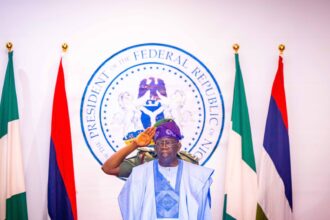

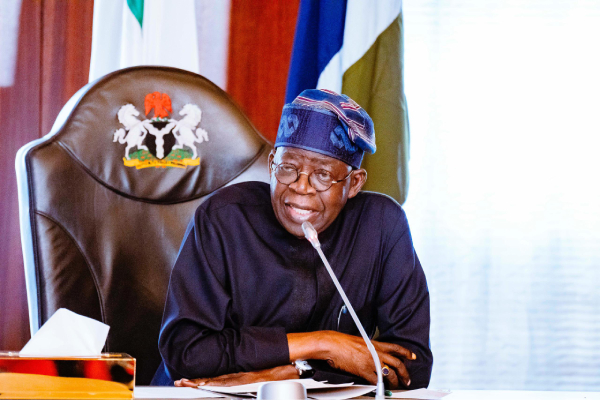
President Bola Tinubu has formally written to the Senate to authorize a new $516m loan request.
The $516m loan request which is said to be for Sokoto–Badagry superhighway was contained in a letter addressed to the President of the Senate, Godswill Akpabio, and was read during the plenary session on Thursday, April 23, 2026.
The proposed loan, to be sourced from Deutsche Bank AG, is specifically earmarked for the construction of Sections 1, 1A, and 1B of the ambitious 1,000-kilometer road project.
Tinubu urged lawmakers to grant the $516m loan request, stressing the strategic importance of the infrastructure project.
“The purpose of this communication is to formally request the resolution of the National Assembly… to approve a proposed foreign financing arrangement of a syndicated loan facility of US$516,333,007 for the construction of the Sokoto–Badagry Superhighway Project,” the President wrote.
He described the project as a strategic initiative to open Nigeria’s northwest–southwest economic corridor by constructing an approximately 1,000-kilometer high-capacity carriageway linking Sokoto, Kebbi, Niger, Kwara, Oyo, Ogun, and Lagos States, stretching from Illela to Badagry.
The request was subsequently referred by Akpabio to the Senate Committee on Local and Foreign Debts for consideration, with a report expected within one week.
Contributing to the debate, Senator Adamu Aliero described the project as long overdue, noting that it had remained on the drawing board for over five decades.
“I commend Mr. President for initiating what I call a landmark project. This is a project that has been in contemplation for more than 50 years, and today it is becoming a reality,” he said.
Aliero disclosed that he had personally inspected sections of the road already completed and under construction, adding that the use of reinforced concrete and solar-powered street lighting reflects modern infrastructure standards.
“This superhighway will drastically reduce travel time between Sokoto and Lagos from about 13 hours to approximately six hours. It will transform economic activities across the northwest, north-central, and southwest,” he added, urging lawmakers to support the approval when the committee submits its report.
In his remarks, Akpabio described the project as a major economic catalyst capable of boosting productivity and saving lives.
“This is a major economic game changer. Borrowing for critical infrastructure like this is justified, especially when it will generate long-term economic benefits and improve the quality of life for Nigerians,” Akpabio said.
He stressed the need for expedited legislative action, urging the committee to fast-track its review to enable timely consideration by the Senate.
The latest loan request comes amid broader efforts by the Federal Government to manage its financing needs through both external and domestic borrowing, even as fiscal pressures intensify.
This comes as the government is also planning to raise N700 billion from the domestic bond market in April 2026, according to an offer circular issued by the Debt Management Office.
The auction, scheduled for April 27 with settlement on April 29, will involve the re-opening of existing bonds across three tenors – 2030, 2032, and 2035.
The offering includes N300 billion of the 17.945 per cent FGN August 2030 bond, N100 billion of the 17.95 per cent FGN June 2032 bond, and N300 billion of the 22.60 per cent FGN January 2035 bond. With a minimum subscription set at N50.001 million, the issuance is clearly targeted at institutional investors such as pension funds, banks, and asset managers.
Also, recent fiscal data further illustrate the mounting strain. Nigeria’s total debt servicing bill rose to about N16 trillion in 2025, up from N13.02 trillion in 2024, an increase of nearly 23 per cent.
Public debt stood at approximately N159.28 trillion as of December 2025 and is projected to exceed N170 trillion following new borrowings.