
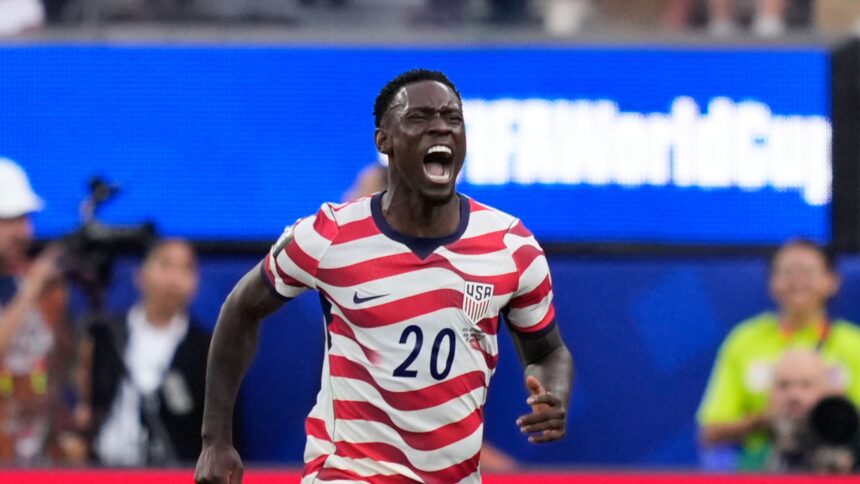
The United States (U.S) Men’s National Team defeated Paraguay 4-1 in their biggest win at the World Cup tournament.
While the brilliant display of the team has been on the headlines, many have begun to point out that our immigrants played a huge role in how the U.S defeated Paraguay on Friday.
At SoFi Stadium, young stars with roots from far and wide shone brightly, proving once again that America’s strength lies in its beautiful diversity.
Monaco striker Folarin Balogun, born in Brooklyn to Nigerian parents, stole the show with a first-half brace, becoming the first American man to score multiple goals in a World Cup match since 1930.
This milestone win wasn’t just a triumph for American soccer—it underscored a long-standing truth: immigrant talent and heritage have been instrumental in elevating U.S. soccer on the global stage.
From the very first World Cup in 1930, when the U.S reached the semifinals with a squad largely composed of immigrants and working-class players from Northeastern migrant communities, foreign-born or first-generation athletes have fueled American success. Fast-forward to 2026, and the USMNT roster reflects the nation’s melting-pot strength.
Many players are children of immigrants from countries like Nigeria, Liberia, Jamaica, Mexico, Guatemala, and El Salvador.
Others, such as Sergiño Dest (Netherlands), Antonee Robinson (England), and Malik Tillman (Germany), were born abroad but hold U.S. ties through parents or naturalization and chose to represent the Stars and Stripes.
Balogun’s story perfectly embodies this. His Nigerian parents were visiting New York when he was born, granting him U.S. citizenship by birth. Raised in England, he later committed to the U.S., bringing world-class finishing to the team.
This success arrives amid evolving U.S. immigration policy. Under the administration of United States President Donald Trump, an executive order has sought to limit birthright citizenship (guaranteed by the 14th Amendment) for children born in the U.S. to certain non-citizen parents—specifically, those where the mother is unlawfully present or on temporary lawful status, and the father is not a U.S. citizen or lawful permanent resident.
While legal challenges continue and the order primarily affects post-2025 births, it raises questions for future generations of dual-national or immigrant-heritage athletes.
Players like Balogun, whose citizenship stemmed from being born on U.S. soil during a family visit, highlight how birthright citizenship has expanded the talent pool.
Restricting it could narrow eligibility pathways for American-born stars with immigrant roots in the years to come, potentially altering the makeup of future USMNT squads that have thrived on inclusivity.