
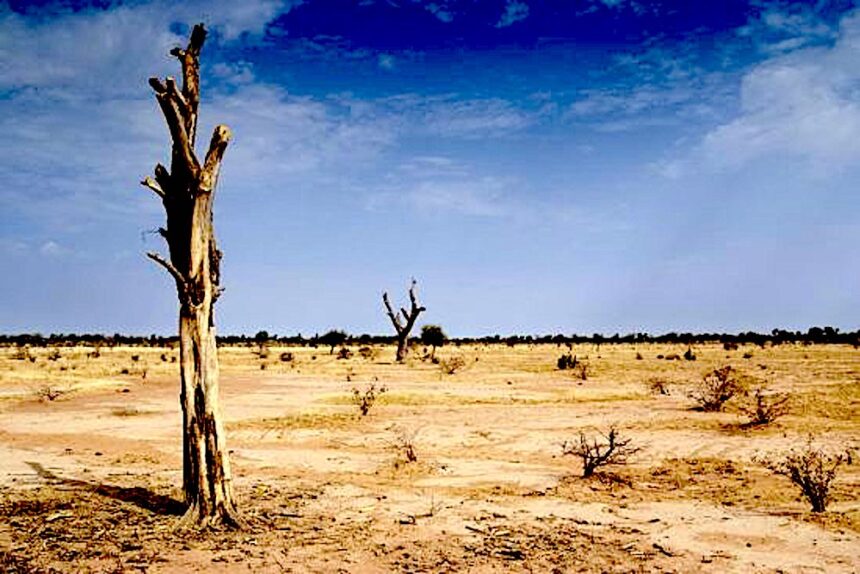
Environmental experts in collaboration with the Citizens Free Service Forum (CFSF), have raised a critical alarm over an escalating ecological crisis that is causing Nigeria to lose an estimated 350,000 hectares of land annually to desertification and severe land degradation.
During an online expert training on desertification in Nigeria, particularly in Northern Nigeria, monitored by Pan-Atlantic Kompass, the experts warn that the desertification in Northern Nigeria is fast evolving into a full-blown national security and economic threat.
Pan-Atlantic Kompass reports that consolidated data from the National Agency for the Great Green Wall (NAGGW) and environmental watchdogs revealed that desertification now impacts over 43% of Nigeria’s total landmass.
The crisis directly threatens the food security and livelihoods of more than 40 million Nigerians living across the country’s northern belt.
In the frontline states—including Sokoto, Kebbi, Katsina, Jigawa, Kano, Borno, and Yobe—between 50% and 75% of the arable land is actively desertifying.
Executive Director of Citizens Free Service Forum (CFSF), Comrade Sani Baba, in his opening address stated that: “I am sure you will agree with me that all parts of Nigeria are beset with climate impacts. From rising sea levels, coastal erosion, gulley erosion, and loss of forest cover and biodiversity, we make bold to say we are under assault. If we take the situation happening in about 14 states of the north where the Sahara continues to march downwards, this Expert Workshop on Desertification in Northern Nigeria is timely.
“Desert encroachment affects nearly 45% of Nigeria’s landmass in the northern part of the country. Some of the affected states are Adamawa, Borno, Gombe, Yobe, Jigawa, Katsina, Kebbi, Sokoto, and Zamfara with studies showing that the region loses about 350,000 hectares of land annually.
“Climate change has resulted in Lake Chad declining from 25,000 square kilometers in the 1960s to less than 1,500 square kilometers as we speak. This decline not only affected space; It has affected the livelihoods of over 40 million people who were fisherfolk and farmers. The region is now experiencing dwindling or no rainfall.”
Speaking specifically to the causes of desertification in Nigeria, Executive Director Centre for Transparency Advocacy/Coordinator Women in Extractives, Nwadishi Faith pointed out that the critical drivers behind the 350,000-hectare annual loss are due to deforestation, overgrazing, unsustainable farming, and weak policy enforcement.
Faith said: “So, what are the causes and drivers of land desertification? One is because you have pressure on the earth, you have environmental triggers like too much rain, too much dry season, so you have extreme weather events that will lead to over-exploitation, resource extraction, mining, firewood, getting the wood out of the forest, deforestation, all of those things lead to that.
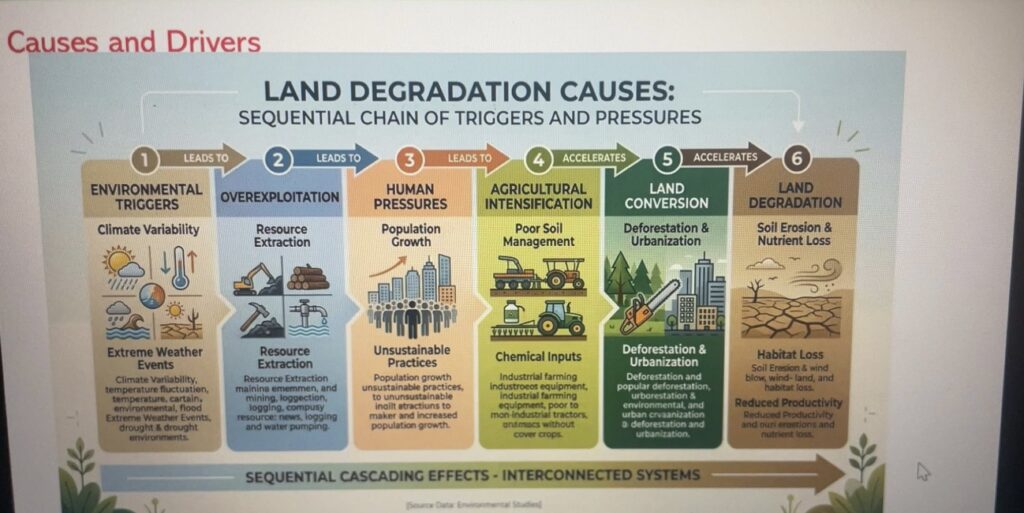
“While this is happening, the population is growing, they’re also trying to recover land for development, for building, and all of those. Where you have the climate pressures, you have human activities, you have agricultural activities also, and you have people who are using chemicals.
“Sometimes we think that some of the fertilizers we are using, we are using them to help us, but it’s also destroying the land, it is depleting the natural chemicals that you have within the land, and of course, it leads all of these activities leads to land desertification.
“And the fact is that when we are doing all of this, we are thinking that it’s development, that we are doing well, we’re bringing out farm produce. Meanwhile, in those days what communities used to do is that they will give out land to people, you farm them for two, three years, and you allow that land to recover for another five, seven years before people will go back there, rather what they do now, instead of allowing land to recover, you see them using fertilizers, and then, which eventually leads to land desertification.”
Giving context on the impact of desertification in Nigeria, Faith added: “In 1963, this was the chart covering Chad, Nigeria, Niger, Cameroon, and then as at 2001 we are seeing that Lake Chad is almost completely dry.
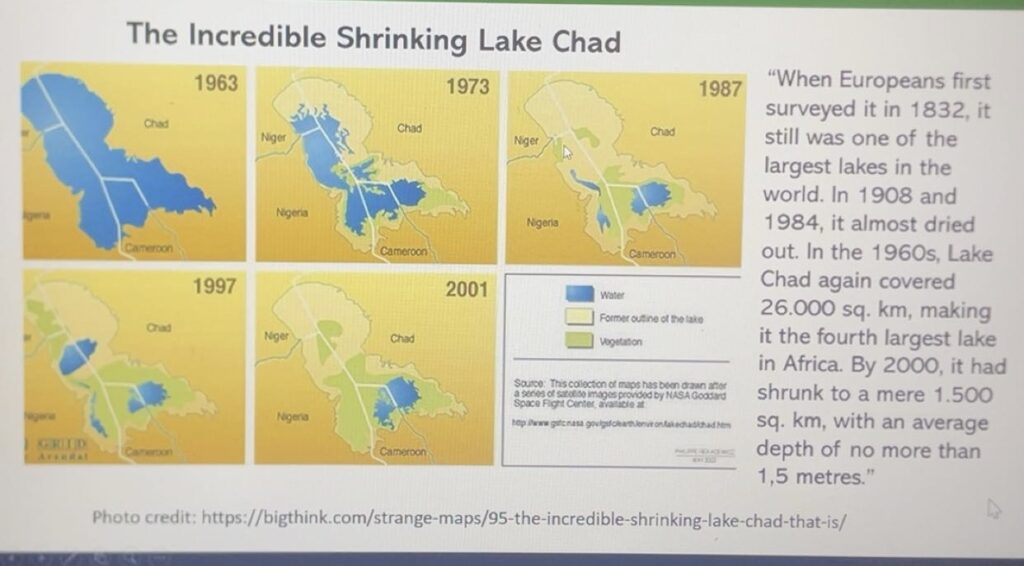
“Lake Chad used to be described as one of the largest lakes in Africa, and even initially it used to have the deepest part, about seven meters, but now it’s just about 1.5 meters. That means you have lost about 5.5 meters of that water, so it’s really scary. It’s something that everybody should be interested in.”
In her address, a Chartered Management Consultant, Azizat Mohammed, widened the discussion on how desertification affects women in Nigeria.
She asserted that women make up a large percentage of Nigeria’s agricultural workforce, particularly in rural smallholder farming.
However, Mohammed stated that, due to customary laws, women own less than 15% of the farmland.
This, according to her, means women lack the title to the land they cultivate, they lack the collateral needed to secure bank credit, microloans, or emergency government bailouts as desertification reduces crop yields in Northern Nigeria.
She stated: “This desertification has been seen as an environmental crisis. So, every time we talk about desertification, they look away and they say it’s for the science people, or it’s desert now, we’re in Nigeria, and Nigeria is not a deserted region.
“And so we have not given the right focus to the things that we needed to focus on, and that’s why we have been seemingly losing the fight against desertification, because for millions of women in Northern Nigeria, it is not just an environmental crisis, it is an economic crisis, a health crisis, a food security crisis, and a social welfare challenge.”
She continued: “Women are at the intersection of gender and environmental vulnerability in any manner you want to look at it. Who are these women we’re talking about?, They are in the rural areas, especially in these states where desertification has started in northern Nigeria.
“These women are responsible for the smallholder farming, rural farming, and subsistent farming. They are the food processors. They are the ones who will take your yams and convert them to amala flour, or take your wheat and convert it to wheat flour, or take your maize and convert tuwo.
“They are the food processors, they are the water collectors, they are also the primary caregivers at home, and of course, they are the household managers.
“What is the government, or what is the society cheating them out of? One, you rarely see women in these areas, having land ownership rights. How many of them can claim is a C of O and document in their names, not even when it becomes a legal inheritance issue for a lot of women, and then, of course, when it comes to access credit and finance, either they are found short in the structure of their business to be able to access this finance, or in their level of education, which also affects their decision-making power in the society.
“Climate information access is also limited, because a lot of them are not schooled, and then finally, political representation.
“And finally, what are the results? We have disproportionate exposure, the women at the forefront of the impact of desertification, either as wives, as mothers, as caregivers, or whatever roles they are experiencing, have a reduced coping capacity naturally.
“When you start planting in a small portion of land, you’re able to feed your family, when that land is no longer able to even give you the small food that you’re going to rely on, it’s a problem, and of course, there’s heightened health risks and deeper marginalization, all of what will be seen, so women experience the effects of desertification differently, and almost always more severely.”