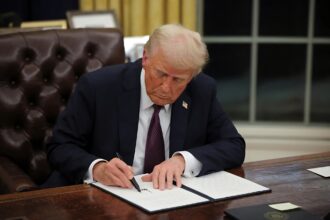

The United States (U.S) government under the administration of President Donald Trump has announced a new final rule that imposes green card bans for immigrants benefiting from public aid.
Published in the Federal Register, this new rule rescinds a 2022 Joe Biden-era policy and grants immigration officers expanded authority to deny permanent residency to noncitizens who utilize, or are deemed likely to utilize, taxpayer-funded public benefits.
The new green card bans on immigrants benefiting from public aid rule is scheduled to take effect on September 18, 2026.
Under immigration law, the U.S government can deny a visa or green card to any individual deemed likely to become a “public charge” (primarily dependent on government assistance).
However, how this rule is interpreted varies heavily by administration.
The 2022 Biden rule limited the public charge review almost exclusively to cash welfare payments (like SSI or TANF) and long-term institutional medical care.
However, the Trump administration has now rescinded those limitations. U.S Citizenship and Immigration Services (USCIS) officers can now look at a much wider safety net of non-cash benefits—including Medicaid, Supplemental Nutrition Assistance Program (SNAP/food stamps), and housing vouchers—when conducting green card evaluations.
This was contained in a press release posted on the website of USCIS.
The statement reads: “The Department of Homeland Security (DHS) has issued a final rule rescinding the 2022 Biden-era regulation regarding public charge determinations, further aligning immigration law with Congressional intent that aliens in the United States be self-reliant and not dependent on taxpayer-funded government benefits. Under the Immigration and Nationality Act (INA), an individual applying for a visa, admission, or adjustment of status is inadmissible to the United States if deemed likely at any time to become a public charge.
“The now-rescinded Biden-era regulation restricted which public benefits DHS could consider, limiting officers’ ability to review all relevant factors as intended by Congress. With this final rule, USCIS officers are empowered to assess all pertinent facts on a case-by-case basis for each applicant.
“The Trump administration is upholding the rule of law and protecting American taxpayers from subsidizing aliens who may become dependent on public benefits. USCIS is committed to safeguarding the safety, security, and financial well-being of Americans,” said U.S. Citizenship and Immigration Services spokesperson Zach Kahler.
“The rule will take effect on Sept. 18, 2026. USCIS will publish a revised Form I-485, Application to Register Permanent Residence or Adjust Status. Older versions of Form I-485 postmarked or submitted electronically on or after the effective date will not be accepted.”
The final rule stated the Biden administration’s policy put a “straightjacket” on Department of Homeland Security officers by hampering their ability to make public charge inadmissibility determinations.
Meanwhile, several immigration experts have criticised the green card bans on immigrants on public aid.
Critics argued that the lack of guidance opens the door to immigration officers arbitrarily rejecting applicants while discouraging immigrants from asking for assistance.
“The reach of this rule extends far beyond immigrants coming into the United States. It is designed to punish the citizens this administration dislikes: those in mixed-status families,” American Immigration Lawyers Association (AILA) Executive Director Benjamin Johnson said in a statement.
“U.S. citizens who are fully eligible for benefits will forgo health care, nutrition assistance, and other basic supports out of fear that using them could jeopardize a loved one’s immigration status. That is short-sighted, and the consequences for public health and economic stability will be felt in communities across the country,” Johnson added.
Roughly 1 in 5 Americans are enrolled in Medicaid, while about 12 percent receive food stamps. The programs are available only to those who are lawfully present in the United States, and with Medicaid, migrants are only able to receive care if their state has agreed to cover the cost.
“The Trump administration is once again weaponizing the federal government to make immigrants afraid to go to the doctor, buy food at the grocery store, and even file taxes,” Sarah Krieger, the senior policy counsel at the National Immigration Law Center, said in a statement. “With this new rule, they are sowing fear and chaos to ultimately reshape America into a country where only the few who are white and ultra-wealthy are welcome.”