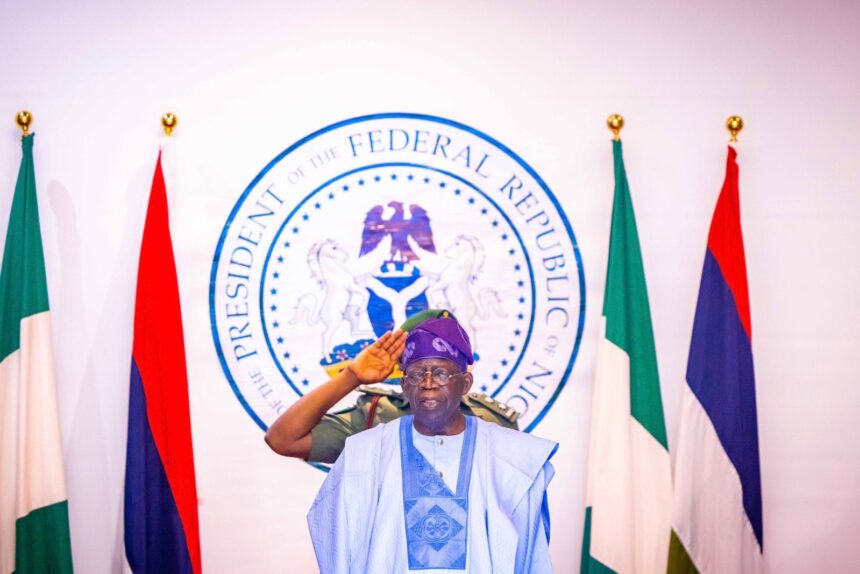
In a bold diplomatic gesture reflecting rising frustrations over targeted violence against Nigerians, President Bola Tinubu snubbed a high-level delegation dispatched by South African President Cyril Ramaphosa.
The South African delegation—led by the Minister of International Relations and Cooperation, Ronald Lamola—arrived in Abuja bearing a message intended to cool diplomatic tempers following renewed xenophobic attacks and tragic fatalities among Nigerian nationals in South Africa.
However, Tinubu snubbed the South African envoy, opting not to grant them an audience while directing the team instead to meet with Nigeria’s Minister of State for Foreign Affairs, Ambassador Sola Enikanolaiye.
The development came amid growing concerns over persistent xenophobic attacks against Nigerians in South Africa.
Sources familiar with the matter said the South African delegation arrived in Abuja on Friday, July 24, with what was described to Nigerian officials as a “very important message” for the Nigerian leader.
Diplomatic sources disclosed that Nigeria’s Minister of Foreign Affairs, Ambassador Bianca Odumegwu-Ojukwu, advised the Presidency that it was not an appropriate time for President Tinubu to receive the South African envoy and members of his delegation.
According to the sources, the minister cited the continued attacks on Nigerians, their businesses and properties in South Africa as a reason for the advice.
The foreign affairs minister stressed that the South African delegation could not be granted an audience with the President without a prior appointment and concrete commitments from Pretoria.
She was said to have insisted that South Africa must first show concrete commitments and present a signed copy of the Memorandum of Understanding, MoU, on the Early Warning Mechanism, EWM, which both countries signed in Abuja on October 22 last year, before further diplomatic engagement could proceed.
Meanwhile, the Nigerian government during the meeting has issued a firm demand to the South African government to take immediate, decisive action to end the recurring xenophobic and Afrophobic attacks targeting Nigerians and other foreign nationals residing in South Africa.
The position was communicated during a high-level diplomatic meeting in Abuja involving a delegation sent by Ramaphosa and Enikanolaiye.
Enikanolaiye stated: “We’ve seen a pattern emerge as early as 1995, in 1998, in 2006, in 2015, in 2016, 2019, 2021, 2024, and 2026. It is on record that from 2022 alone, 98 Nigerians have died in mob actions, in hate-related actions that we have called Afrophobia, because we found that the primary victims of this ugly situation are Africans, and Nigerians in particular,” the minister said.
“So, we appreciate the warm sentiments you have expressed. We also reciprocate our desire for us to maintain excellent relations and take urgent, concrete measures not just to build confidence but to address these ongoing Afrophobic attacks, of which we thought enough has got to stop—which is why we thought we should discuss firmly.”
According to him, migration is a “fact of history”, and anyone who violates the laws of their host nation should be treated in accordance with laid-down rules and regulations.
“If there are criminals, as you alluded to them, we reiterate that the solution is not to kill them. I mean, we’re a country governed by the rule of law. If someone is, quote-unquote, a criminal for drug trafficking, there are rules and regulations: get them arrested, prosecuted, and jailed. The Nigerian government will not support drug peddlers. But please, what we are saying is to treat them in accordance with your constitution, in accordance with international human rights instruments, and in accordance with the minimum requirements of humanity.
“But what we have found is that these xenophobic attacks have gone beyond attacks on criminals. We have records of Nigerians who have legitimate papers to remain in South Africa, yet they have been attacked.
“And we could see some mob actions where we saw the police watching as if they were helpless to address this situation, which to us raises issues of state responsibility. They raise issues of complicity if the state authorities are not able or are unwilling to tackle these challenges in a manner that offers some confidence to citizens and foreigners that, indeed, they are safe to remain in the country.”
Ambassador Enikanolaiye said President Bola Tinubu directed the meeting to address the persistent attacks against Nigerians in South Africa in a frank manner.
The minister urged the South African government to take urgent and concrete steps to end what Nigeria described as recurring Afrophobic attacks against Nigerians and other African nationals, warning that the violence threatens decades of strategic partnership between Africa’s two largest economies.
Enikanolaiye recalled Nigeria’s support for South Africa’s liberation from apartheid and the close collaboration between both countries in transforming the Organisation of African Unity into the African Union, as well as advancing the New Partnership for Africa’s Development (NEPAD).
Pan-Atlantic Kompass reports that for months, South Africa has been the scene of protests against African immigrants that demonstrators have blamed for crime, unemployment and a strain on public services.
Since the recent wave of attacks against Nigerian immigrants in South Africa, Nigeria has evacuated about 1,500 Nigerians.