
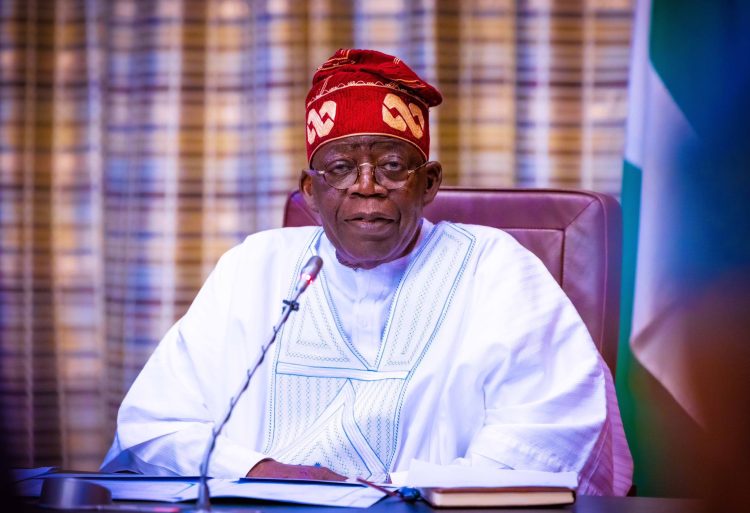
The Independent National Electoral Commission (INEC) officially published President Bola Tinubu’s personal credentials and affidavit forms (Form EC9).
INEC also published the credentials of Tinubu’s running mate, Kashim Shettima.
The physical display across state offices nationwide and publication on the INEC Candidate Nomination Portal aimed to give the public access to candidate qualifications ahead of statutory filing deadlines.
Pan-Atlantic Kompass reports that the Form EC9 is an affidavit in support of personal particulars sworn before a Commissioner for Oaths. It details educational achievements, work experience, age, and citizenship declarations.
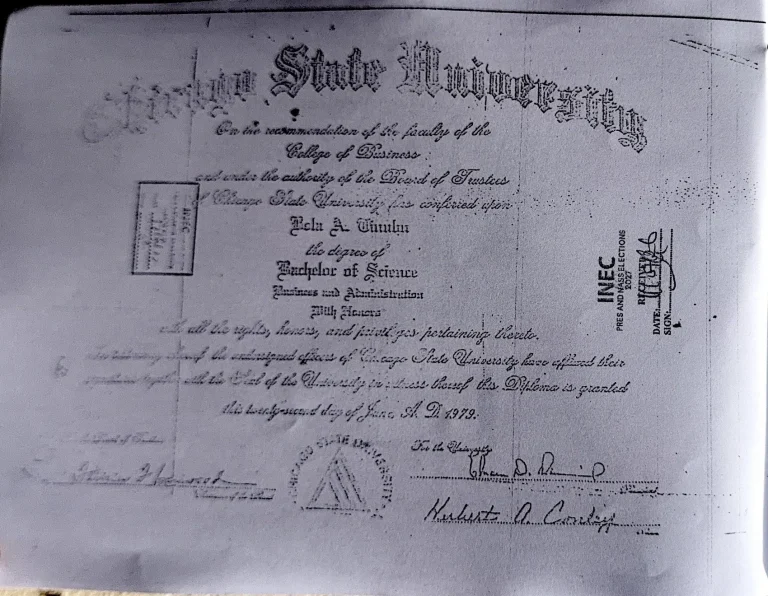
A copy of Tinubu’s Form EC9 credentials showed his Bachelor of Science degree in Business Administration from Chicago State University, United States, which his transcript indicated was awarded “with honours” on June 22, 1979.
The form also carried his National Youth Service Corps discharge documents, which showed he served in Oyo State from December 1982 and was demobilised in November 1983.
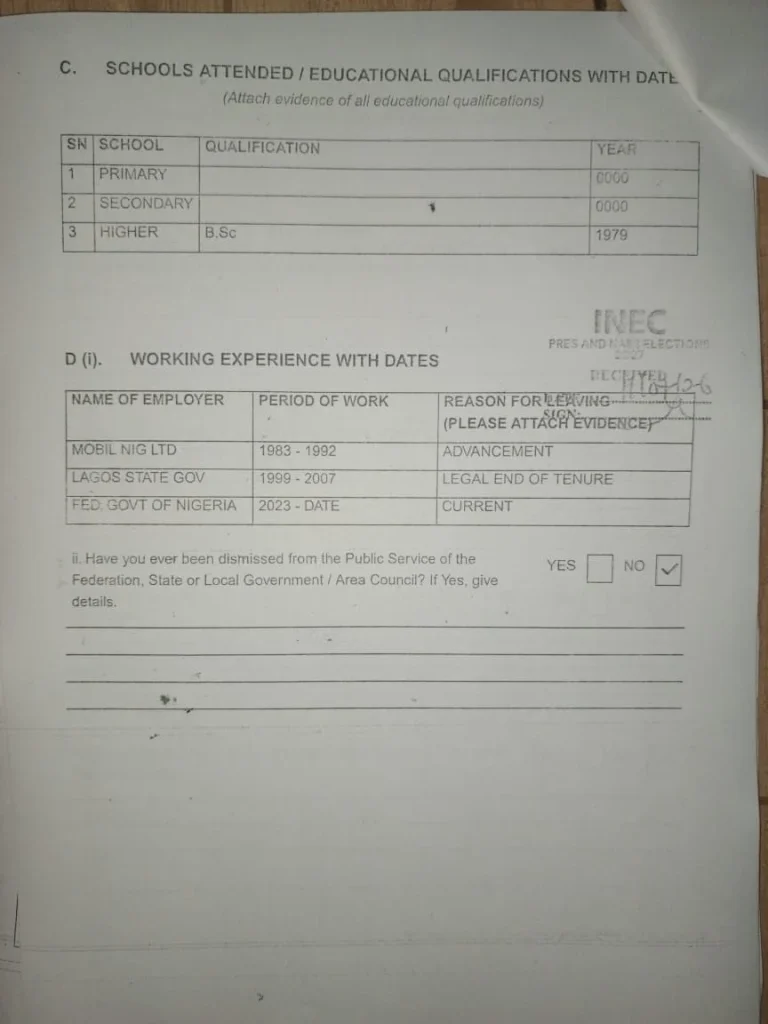
However, Tinubu failed to provide details of his primary and secondary education. He only listed his university qualification, indicating that he obtained a BSc degree in 1979.
His certificate from Chicago State University (CSU) was also included in the documents. Tinubu’s CSU certificate was the subject of intense public controversy in the lead-up to the 2023 presidential election.
Recall that allegations emerged during the 2023 presidential election that the Bola Tinubu who attended CSU was not the current president of Nigeria
In the lead-up to the 2023 presidential election, Tinubu did not provide details of his primary and secondary education in the personal particulars he submitted to INEC.
His work history, as listed in the form, showed three employers: Mobil Nigeria Limited, where he worked from 1983 to 1992 and left on account of “advancement”; the Lagos State Government, where he served from 1999 to 2007 until the “legal end of tenure”; and the Federal Government of Nigeria, where he has worked from 2023 to date.
The years listed against his primary and secondary school attendance in the same form were entered as “0000,” with only his university qualification, a B.Sc obtained in 1979, indicated.
The President’s personal information section listed his date of birth as March 29, 1952, and his age as 74.
It also listed his birthplace as Lagos, his residential address as No. 4, Queen’s Drive, Ikoyi, and his occupation as “politician.”
For Shettima, the displayed documents traced his education from primary school.
His Certificate of Primary Education, issued by the Ministry of Education, North-Eastern State, showed he attended Lamisula I Primary School between 1972 and 1978, finishing second out of 22 pupils in his final year, with English, History and Religious Knowledge listed as his strongest subjects.
His West African Examinations Council result, obtained at Government Secondary School, Potiskum, in June 1983, showed six credits and passes, including a distinction in Religious Knowledge and Economics.
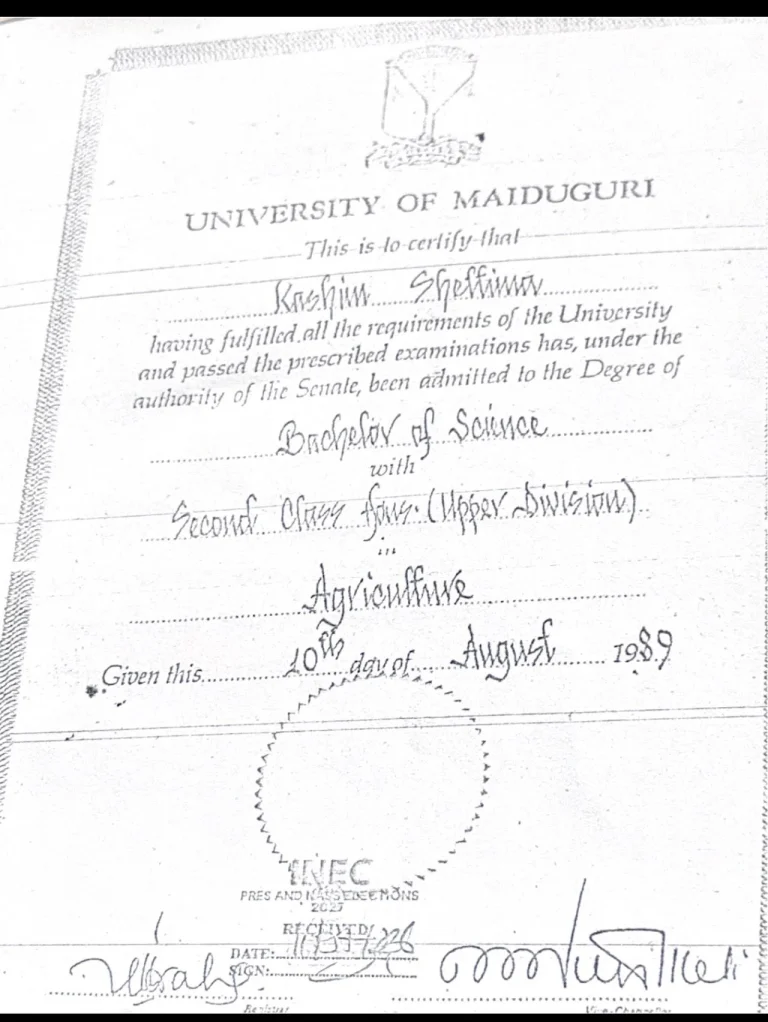
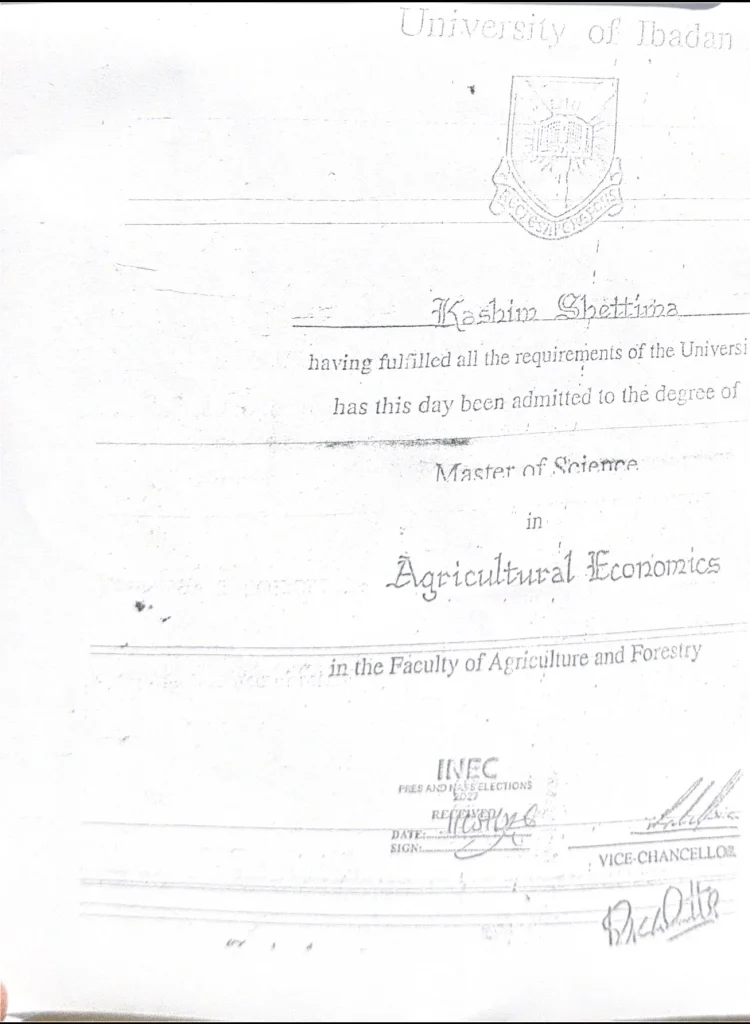
He proceeded to the University of Maiduguri, where records showed he bagged a Second Class Upper Division degree in Agriculture in August 1989, before earning a Master of Science in Agricultural Economics from the University of Ibadan.
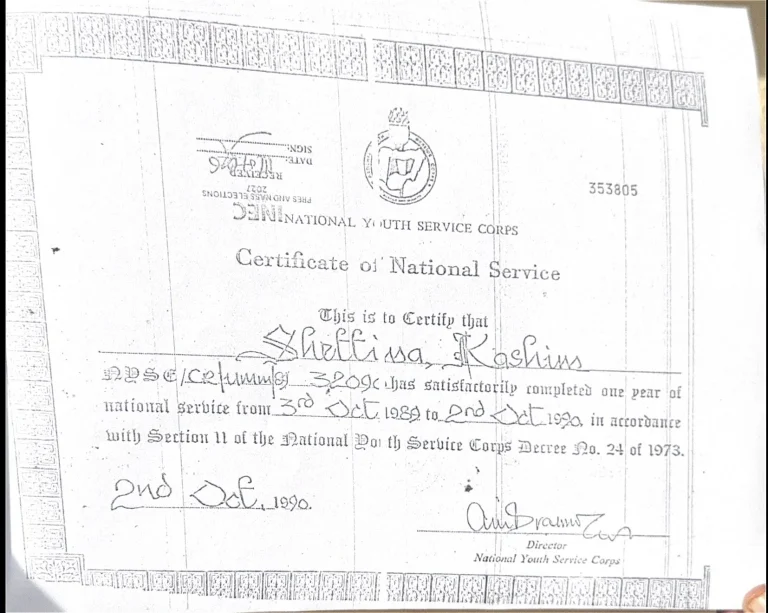
His NYSC discharge certificate indicated he served from October 1989 to October 1990.
The display, contained in Form EC9, is a statutory requirement under Section 29(3) of the Electoral Act, 2026, which mandates INEC to publish candidates’ particulars within 21 days of receipt.
In a statement, the commission explained Form EC9 contains the credentials, personal particulars and affidavits submitted by candidates.
“Form EC9 contains the credentials, personal particulars and affidavits submitted by candidates sponsored by political parties,” INEC stated.
The documents were displayed at INEC offices nationwide, including its Lagos State office in Sabo-Yaba and Local Government Area offices within affected constituencies.
The Electoral Act empowers members of the public to apply to INEC for certified true copies of nomination forms and other documents submitted by candidates, and to seek legal redress over allegations of false declaration or forgery.