
Nigeria has intensified Ebola checks and surveillance at its major international airports following the medical evacuation of the country’s first confirmed case, a Swiss national, to Switzerland on October 26, 2026.
The move comes amid a widening Bundibugyo strain outbreak originating in the Democratic Republic of the Congo (DRC) that has reached East, Central, and West Africa.
Health Minister Muhammad Ali Pate confirmed the patient, a 42-year-old Ugandan-born wife of a Swiss diplomat based in Abuja, departed Nnamdi Azikiwe International Airport early Monday on a medical evacuation flight.
She was clinically much improved, stable, conscious, and communicating, with laboratory results approaching baseline, though she remained potentially infectious. Her asymptomatic husband accompanied her under strict protocols.
It was gathered that the Ugandan-born wife of the diplomat is now being treated at Geneva University Hospitals for the Bundibugyo strain of Ebola
Recall that the patient tested positive after returning to Abuja from travel involving Uganda around October 3. Nigeria confirmed the imported case on October 20, the first in more than a decade.
Following the development, the World Health Organization noted that Nigeria currently has no active Ebola cases after the transfer, while authorities continue monitoring about 52–53 contacts.
Nigeria Boosts Airport Ebola Checks
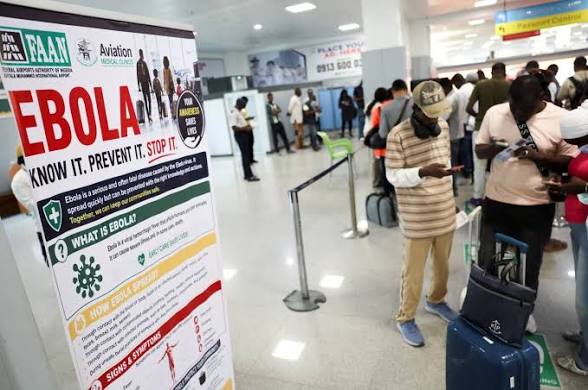
Meanwhile, authorities in Nigeria have ramped up Ebola checks at priority international airports in Lagos, Abuja, Enugu, Kano, and Port Harcourt.
The Nigeria Centre for Disease Control and Prevention (NCDC) expanded health declaration requirements to all international arrivals (previously limited to select countries linked to the outbreak).
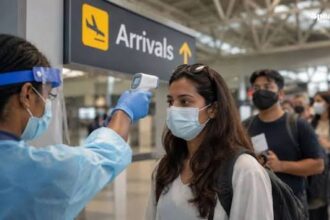
Measures include temperature screening, travel history tracking, digital health declarations, and closer coordination among Port Health Services, the Federal Airports Authority of Nigeria (FAAN), the Nigerian Civil Aviation Authority, immigration, and customs.
Lagos State has specifically tightened passenger screening at Murtala Muhammed International Airport and bolstered surveillance in health facilities. Aviation Minister Festus Keyamo directed stronger response protocols, including no-fly restrictions for contacts during the 21-day incubation window. Domestic flights have seen limited additional measures in some reports.
Director-General of the NCDC, Dr Jide Idris, announced that Nigeria was expanding health screening at its international entry points and reversing an earlier directive that had limited health declaration procedures for international arrivals.
Speaking during a media briefing in Abuja, Idris said the NCDC was returning to a broader screening approach covering passengers arriving from all countries.
Idris identified Lagos, Abuja, Enugu, Kano and Port Harcourt as the five international airports where port health services and other relevant agencies were coordinating preparedness and screening activities.
He explained that passenger health declaration procedures had previously been adjusted during a period of reduced international activity, but the emergence of the confirmed case had prompted a reassessment.
He said the decision to restore broader screening would be implemented in collaboration with aviation regulators, airport authorities, airlines, immigration and customs officials.
The NCDC boss noted that effective border surveillance depended on coordination among agencies with different responsibilities at airports and land borders.
The renewed screening measures are intended to identify travellers who may require further assessment based on their symptoms, travel history or possible exposure.
However, he stressed that surveillance at entry points must complement community-based detection, laboratory testing and contact tracing.
Seeking to reassure Nigerians amid public concern, Idris said the Federal Government, through the Federal Ministry of Health and Social Welfare, the NCDC, FCT health authorities and their partners, was responding to the situation with urgency.
“Ebola is a serious disease, and we are handling this situation with the urgency it deserves,” he said, adding that Nigeria had a clear response plan, experienced personnel and an established public health system to manage the threat.
Other Countries Implementing Airport Screening for Ebola
Aside from Nigeria, several nations have strengthened airports and border checks in response to the Ebola outbreak.
– Ghana enhanced surveillance and airport screening at facilities including Kotoka International Airport after cases appeared in Nigeria and Kenya, citing direct flights and travel volumes as elevated risks.
– Uganda stepped up screening at Entebbe International Airport (a transit point for the Kenya and Nigeria index cases) and land borders. Officials added temperature scanners, conducted inspections, and warned of legal action under public health laws for travelers concealing symptoms.
– Kenya introduced tighter screening at Jomo Kenyatta International Airport for arrivals from 10 countries (including the DRC, Uganda, Tanzania, Rwanda, Burundi, and others). Flights from these locations face enhanced checks, health declarations, and symptom screening.
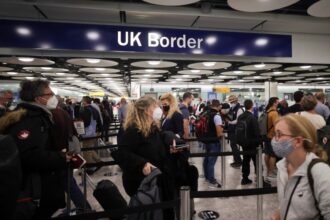
– The United States has maintained entry restrictions related to the DRC, Uganda, and South Sudan and is implementing a new requirement (effective November 3, 2026) for all US-bound air passengers to attest they have not been in the DRC in the prior 21 days. Earlier enhanced screening directed certain travelers through Washington-Dulles International Airport.
These layered approaches—temperature checks, questionnaires, declarations, and targeted restrictions—aim to detect potential cases early, though experts note challenges such as asymptomatic travel during incubation and imperfect thermal screening.
The Bundibugyo Ebola strain has caused thousands of cases and deaths primarily in the DRC since its declaration earlier in 2026, with no widely available vaccine or specific treatment. Nigeria’s swift isolation, contact tracing, and airport upgrades demonstrate ongoing regional preparedness. Officials urge travelers to stay vigilant, report symptoms promptly, and rely on official sources such as the NCDC for updates.