
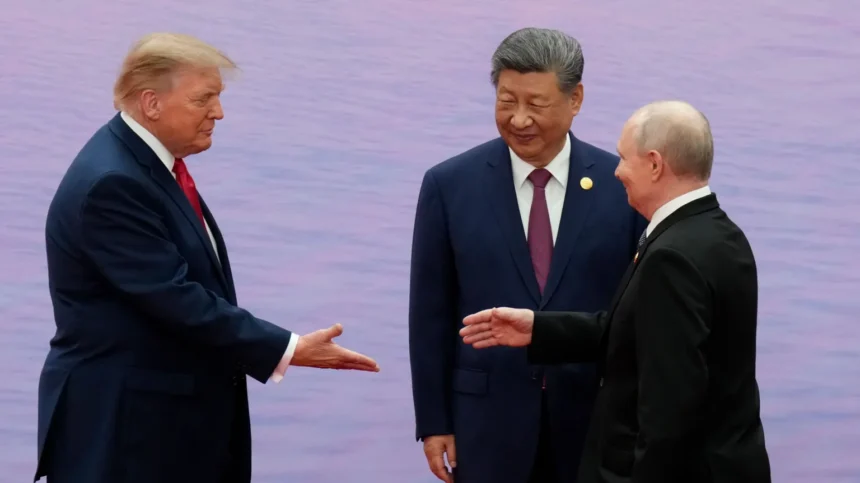
United States (U.S) President Donald Trump, President of China, Xi Jinping, and President of Russia, Vladimir Putin have jointly issued a four-point “peace declaration” following their first-ever trilateral meeting on the sidelines of the Asia-Pacific Economic Cooperation (APEC) summit in Shenzhen.
The 90-minute closed-door session, held at a lakeside villa in southern China, marked the first time the leaders of the world’s three largest nuclear powers have sat down together simultaneously.
Released via Chinese state news agency Xinhua and the Kremlin shortly after Trump departed for Washington, the document outlined shared commitments on nuclear risk reduction, global oil supply, United Nations reform, and limits on international court jurisdiction.
While the summit concluded without immediate policy breakthroughs on active global conflicts, the joint statement establishes four core areas of consensus among U.S, China, and Russia.
Nuclear Risk Reduction: The three leaders reaffirmed the longstanding principle that “a nuclear war cannot be won and must never be fought”. They pledged to open dialogue aimed at preventing nuclear proliferation and reducing strategic risks, a critical step following the February 2026 expiration of the New START treaty between the U.S. and Russia.
Stabilizing Global Energy Flows: Amid ongoing disruptions to Middle Eastern shipping lanes—including repeated blockades in the Strait of Hormuz during the Iran conflict—the three powers committed to increasing the production and supply of refined petroleum products to stabilize global energy markets.
United Nations Reform: As permanent, veto-holding members of the UN Security Council, the U.S., China, and Russia agreed to advance structural reforms within the United Nations so the body can “respond more effectively to global challenges”. Specific proposals were not detailed in the text.
Curtailing International Court Reach: In a pointed rebuke of the International Criminal Court (ICC), the declaration asserts that state officials must enjoy immunity from prosecution and warns international tribunals against abusing their jurisdiction. Both Washington and Moscow have clashed sharply with the ICC—Putin remains subject to an active ICC arrest warrant, while Trump has repeatedly criticized the court for overreach.
Meanwhile, it was gathered that Trump closed the meeting by saying the presidents of three of the world’s largest countries have a “special responsibility” to maintain productive dialogue.
“Too often past leaders have avoided talking to nations with whom they had disagreements,” he said, adding: “We feel the opposite.”
Trump referenced the three countries’ nuclear capabilities and said they are “uniquely positioned to discuss how to reduce the number of nuclear weapons on Earth”.
It is “vital” that they co-operate to “combat the threat of nuclear proliferation in other countries around the world”, he said, adding: “That’s what we’re doing in Iran.”
“We’re not going to let Iran have a nuclear weapon”.
Trump then turned to Ukraine and said he and Putin have had a “long discussion” on the conflict there already.
He added that Putin “and I hope the other side, would like to see an end to that war”.
Putin addressed the media following the trilateral meeting and described it as an “important chapter in the history of diplomacy”.
He said Ukraine and Europe were not yet ready to make compromises to resolve the conflict in Ukraine – but he said Russia had invited EU representatives to Moscow to better understand Europe’s position.
In his reaction, China’s president described his meeting with Putin and Trump as “positive, constructive, and highly productive”, according to the country’s state broadcaster CCTV.
It added that Xi recalled “the history of fighting side-by-side during WW2”, as the three leaders emphasised the importance of “cherishing the hard-won peace”.