
The recent 14% tariff imposed on Nigerian exports to the United States by US President Donald Trump has sparked discussion among economists and analysts as they explore its implications for Nigeria’s economy and international trade relations.
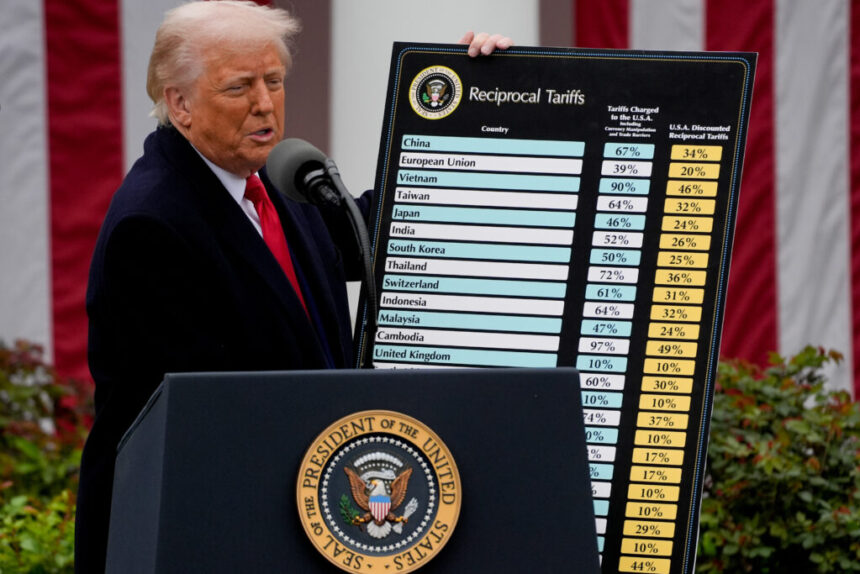
The US President on Wednesday unveiled a sweeping tariff policy, dubbed “Liberation Day,” imposing a 10% baseline tariff on all imports entering the United States, with additional “reciprocal tariffs” targeting specific nations.
Exports from Nigeria to the US will attract a 14% tariff compared to the 27% that the US government claims it receives from Nigeria. The Trump’s tariff is set to take effect on April 9, 2025.
Pan-Atlantic Kompass gathered that Nigeria relies heavily on exports like crude oil, petroleum gas, and nitrogen-based fertilizers to the U.S.
Nigeria’s trade with the United States totalled N31.1 trillion between 2015 and 2024 in almost ten years, according to data from the National Bureau of Statistics (NBS). The data further revealed that total imports within this period were N16.4 trillion or 8.7% of Nigeria’s global exports.
In 2024, these exports generated approximately N931 billion in revenue, according to data from the NBS.
The Trump’s tariff also comes just as the U.S. began importing jet fuel from Nigeria’s Dangote Refinery, with six vessels carrying 1.7 million barrels last month.
However, with the new 14% tariff, many have raised fear that it would affect this income stream by increasing costs for American buyers, potentially reducing demand for Nigerian goods.
Economists warn that this could shrink Nigeria’s export competitiveness, particularly in the oil sector, which forms the backbone of its economy.
The immediate fallout could be a reduction in foreign exchange earnings, putting further pressure on the already fragile naira.
With inflation and living costs already high, a weakened currency might escalate economic challenges for everyday Nigerians.
Job losses in export-dependent sectors like oil and agriculture are also a looming concern, as businesses adjust to shrinking U.S. demand.
On the flip side, some analysts suggest this could push Nigeria to diversify its trade partners.
A non-governmental organisation, the Centre for the Promotion of Private Enterprise has explained that the shocks that the Trump’s tariff may have on Nigeria’s economy.
The chief executive officer of CPPE, Dr Muda Yusuf, in a statement on Thursday, said the vulnerability of the Nigerian economy to shocks of the current trade war unleashed by Trump may be very limited.
Yusuf said Nigeria’s external trade exposure to the United States is about 10 per cent.
The statement reads in part: “The trade war and the subsequent retaliatory tariffs would trigger inflationary pressures in the United States. This may result in elevated costs for imports into Nigeria from the United States. Thirdly, we are likely to witness some level of disruptions in global supply chains resulting from the tariff war. This could dampen the global growth outlook and affect crude oil prices. A decline in the oil price would impact Nigeria’s foreign reserves and revenue.
“The worsening inflation outlook for the US economy may trigger monetary tightening by the US Federal Reserve. This may lead to higher interest rates and trigger portfolio flow reversals in emerging economies. This could have implications for the naira exchange rate.
“But there are also opportunities for new trade partners globally. Many countries that are victims of the current trade war would seek new bilateral trade relationships, which may create opportunities for Nigerian investors,” CPPE added.
A former Nigerian Senator, Shehu Sani, who took to his official X (formerly Twitter) handle, said: “Trump is even fighting America’s neighbours, Canada and Mexico and their traditional European allies, so imposing 14% tariffs on Nigeria shouldn’t come as a surprise. The good side of Trump’s tariff is compelling countries to be less dependent on the US and find alternatives. Trump loves his country first, it’s left for you to love or hate yours.”
Another user on X (@General_Oluchi) said, “With the increased tariffs, buying food exported from Nigeria is going to be too expensive at the diaspora supermarkets. If the customers can’t afford them, they rot. If exporters can’t sell, they won’t ship. But let’s cheer our master strategist, Donald Trump, for putting Nigeria first. His supporters are reeling in excitement. There’s joy in the streets as farmers celebrate their new American godsent!”
In the same vein, a user of X (@AYANFEØ1), said: “The 14% tariff imposed on Nigerian exports might decrease trade with the U.S., rendering Nigerian products less competitive, which could negatively impact businesses reliant on exports, lower foreign exchange revenues, and possibly result in job cuts within the affected sectors.”
While the Nigerian government is yet to react officially to the development, some world leaders have sharply criticized Trump’s latest round of tariffs, calling them a “major blow” to international trade and economic stability.
In a related development, the South African presidency, in a statement, has condemned the new tariffs as “punitive”, saying they could “serve as a barrier to trade and shared prosperity”.
“We now have to look amongst ourselves and say, within the customs union in southern Africa… how we’re going to respond to these issues,” South Africa’s Trade Minister Parks Tau say.
Also, Lesotho has said it will send a government delegation to the United States to plead its case after Washington imposed 50% tariffs on its exports, the highest for a single nation.
“We need to urgently travel to the US to engage with its executives and plead our case,” trade minister Mokhethi Shelile told reporters.
He added: “My biggest concern was the immediate closure of factories and job losses.”
In the same vein, a statement issued on Thursday by European Commission President Ursula von der Leyen described the tariffs as “a step backwards for cooperation and prosperity,” warning that they could lead to higher prices for consumers and disrupt supply chains already strained by recent global challenges.
“This unilateral approach risks unravelling decades of progress in free trade,” she added.
Also, Chinese Premier Li Qiang echoed these sentiments, accusing the U.S. of “economic coercion” and vowing to protect China’s interests.
“These tariffs will not weaken our resolve but strengthen our unity,” Li said in a statement broadcast on state media.
Similarly, the International Trade Union Confederation has condemned the Trump administration’s new trade tariffs, warning that the policies could spark a global trade war, lead to job losses, and increase consumer prices.
The global labour organisation condemned the move, describing it as a reckless economic manoeuvre that will disproportionately harm workers while benefiting corporate elites.
In a statement released on Thursday, ITUC reaffirmed that international trade should promote social justice, equitable economic growth, and the creation of decent jobs with fair wages and strong labour rights.
However, it warned that the U.S. government’s weaponisation of Trump’s tariff would have the opposite effect, exacerbating economic inequality and destabilising global markets.
ITUC’s General Secretary, Luc Triangle, said, “These tariffs are not part of any serious plan to support working people.
“The Trump Administration has launched a trade war that will put workers’ jobs and livelihoods at stake. It will also lead to price increases, for which workers and consumers will bear the costs.”