

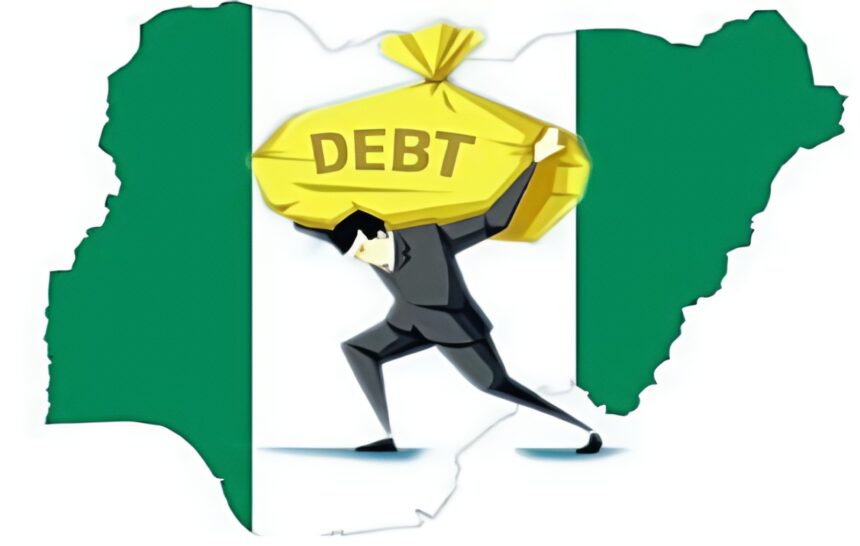
Recent data has indicated that Nigeria’s debt service soared to N16.26 trillion under President Bola Ahmed Tinubu’s administration.
It was gathered that Nigeria’s debt service soared to N16.26 trillion due to several factors, including currency devaluation and the high cost of maintaining existing loans. With the total 2026 budget peaking at over N68 trillion, nearly 24% of the entire federal spending is now directed toward creditors rather than critical infrastructure or social welfare.
Since Q3 2023, when the current administration took office, quarterly debt service has remained elevated, peaking at a record N4.86 trillion in Q4 2025.
This data was contained in a report released by the Debt Management Office (DMO).
A breakdown of the data in the report revealed that every quarter, the upward trend peaked in Q4 2025, with debt service hitting a record N4.86 trillion. This was 37.86% higher than N3.52 trillion in Q3 2025 and 49.93% above N3.24 trillion in Q4 2024, showing a steady rise in debt payments.
A comparison of Nigeria’s debt service trajectory before and during the Tinubu administration shows a clear structural shift in Nigeria’s debt service trajectory.
Pre Tinubu’s Administration (Q3 2019 – Q2 2023)
- Quarterly debt service ranged between N330.82 billion and N1.24 trillion
- Most quarterly payments ranged between N400 billion – N900 billion, averaging at N753.05 billion
- External debt service remained relatively low, averaging N203.41 billion
During Tinubu’s administration (Q3 2023 – till date)
- Quarterly debt service jumped sharply to a new range of N2.46 trillion to N4.86 trillion
- The average rose to N3.47 trillion per quarter
- External debt service surged into the trillion-naira range, exceeding N1 trillion across all quarters except Q4 2023, and peaking at N2.57 trillion in Q4 2025
The major turning point came in Q3 2023, when external debt service surged by 270.78% quarter-on-quarter, driving a 234.78% increase in total debt service. This marked a clear shift from earlier trends and set the stage for the elevated debt service levels observed since then.
Following the Q3 surge, total quarterly debt service remained consistently above N2 trillion and subsequently rose past the N3 trillion and N4 trillion thresholds
External debt has played a central role in this shift. In Q4 2025, external debt service stood at N2.57 trillion compared to N2.28 trillion for domestic debt, pushing external debt’s share to 53%, up from 43% in Q3 2025.
Exchange rate movements also amplified the trend, with the naira moving from N755.27/$ in Q3 2023 to N1,429/$ in Q4 2025. However, the Q4 2025 debt repayment spike occurred despite the naira appreciating to N1,429/$ from N1,478/$ in the previous quarter.
This indicates that the increase was driven by repayment volume rather than by exchange rate pressure.