

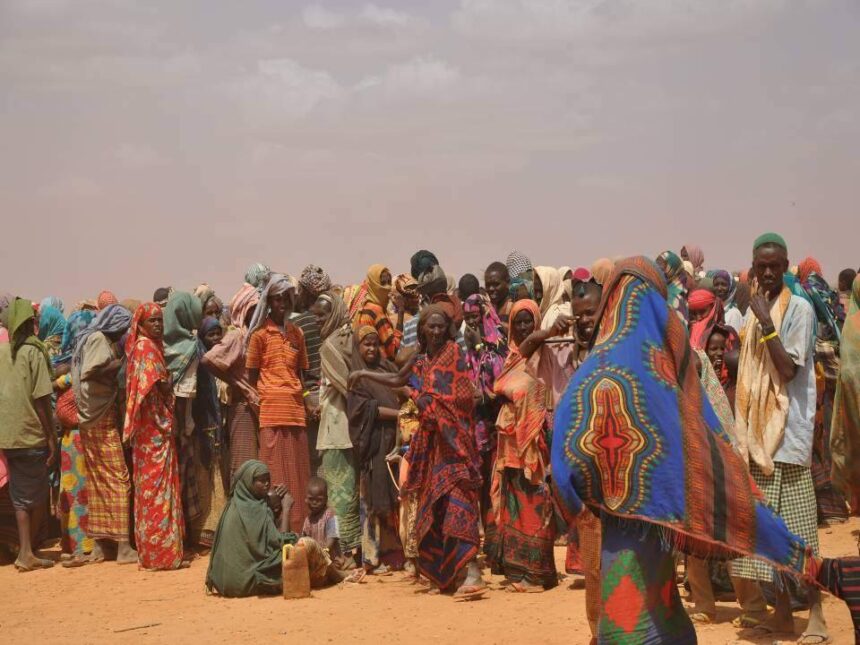
Climate migration in Africa is accelerating at an alarming rate as rising temperatures, prolonged droughts, and extreme weather events displace millions of people across the continent.
From the Sahel region to the Horn of Africa, entire communities are being forced to abandon ancestral lands, sparking one of the largest human movements in modern history driven primarily by climate change.
Recent reports highlight that climate migration in Africa now affects over 100 million people who are either already displaced or highly vulnerable.
It was gathered that Sub-Saharan Africa is now facing some of the most severe impacts, with countries like Nigeria, Somalia, Ethiopia, and Sudan experiencing mass internal and cross-border movements.
Families who once relied on reliable rainfall for farming and livestock herding are watching their livelihoods vanish as desertification advances and water sources dry up.
In 2025 alone, extreme weather events triggered millions of new displacements. The combination of record heatwaves, devastating floods in some areas, and multi-year droughts in others creates a perfect storm that makes traditional ways of life unsustainable.
A World Bank Report estimates that in 2050, climate change could displace 85 million Africans internally in sub-Saharan Africa, with global numbers reaching 200 million.
Below are some of the regions most affected
Drought-Affected Areas
- Horn of Africa (Somalia, Ethiopia, Kenya) – Experiencing prolonged droughts, leading to food and water shortages.
- Sahel Region (Chad, Niger, Mali, Burkina Faso) – Desertification is expanding, making agriculture increasingly difficult.
- Madagascar – Southern Madagascar has faced severe droughts, causing widespread hunger.
Flood-Prone Areas
- Mozambique – Cyclones and heavy rains have led to devastating floods, displacing thousands.
- Nigeria – Seasonal flooding affects communities along the Niger River, destroying homes and crops.
- Democratic Republic of the Congo – Heavy rainfall has caused frequent flooding, worsening disease outbreaks.
Coastal Areas Facing Rising Sea Levels
- Senegal – Coastal erosion threatens fishing communities and infrastructure.
- Egypt (Nile Delta) – Rising sea levels are salinizing farmland, reducing agricultural productivity.
- Tanzania – Coastal cities like Dar es Salaam are increasingly vulnerable to flooding.
Regions Facing Extreme Heat
- Sudan and South Sudan – Rising temperatures are making water scarcity worse.
- Botswana and Namibia – Extreme heat is affecting livestock and agriculture.
- Zimbabwe – Heatwaves are intensifying, impacting food security.
These regions highlight the widespread impact of climate change across Africa.
There have been stories about the negative impact of climate migration in Africa over the years.
Speaking recently during an interview conducted by the United Nations High Commissioner for Refugees (UNHCR), Seybata, a Malian refugee and mother of seven, narrated how she survived the floods in Niamey, Niger.
“I lost everything in the collapse,” says the 38-year-old Malian refugee and mother of seven. “I didn’t have time to empty the house before it fell. I just grabbed my children and got out.”
Also, Zulai Mohammed, 60 years old woman who was displaced by a flood in Maiduguri, Borno State in 2024 said: “I live with my children and grandchildren in one rented apartment. We live in the same compound with about 40 other people.
“Around 12AM we heard an announcement that there was flooding in our area. We were asked to evacuate with our family, but it was too late, the flood had already come.
We were able to escape with just the clothes we had on, and we spent the night sitting by the roadside. The following day, we came to this camp.
“We could not take anything with us, even the food I had cooked. We left home around 12:30AM and have not been able to go back home. Here, at first, there was no food or water. But for the past few days, we have been receiving some. We don’t have mattresses to sleep on, we sleep on the floor.”
Also, Zainab Mohammed, a 25-year-old woman said: “The flood sent us away from our homes. We couldn’t save anything. We were lucky to survive.
“I lived with my husband and three children. We heard the sound of water flowing into our house and by the time we checked, our house had been flooded.
“It was difficult finding a way to escape but luckily, we made it out. We trekked for about two hours before reaching the camp.
“Here we lacked food until a distribution was organized. We would love to be able to go back home because this place is not a good place to stay. But we don’t have anywhere to go because our houses are still flooded. My children are vomiting and have watery diarrhea. It’s not clean here, and that I think may be the reason why my children are ill.”
Meanwhile, several countries across the globe are often violiate to victims of climate migration in Africa. Some of the victims are made to undergo rigorous immigration checks during the process of their migration.
This is because the international community has been slow to recognize climate migration as a pressing issue.
Affected individuals often lack legal protection because they do not qualify as ‘refugees’ under traditional international law definitions.
The 1951 United Nations Refugee Convention provides a narrow definition of ‘refugees’ as individuals fleeing persecution based on race, religion, or political opinion, it excludes those forced to migrate due to environmental changes.
A later AU Refugee Convention took a broader approach by extending it to include those fleeing “events disturbing public order” (such as conflict or disasters). However, implementation remains weak.
The African Union has adopted the Kampala Convention, which addresses internal displacement, including that caused by climate change. Countries like Kenya and Ethiopia are integrating climate resilience into their development plans. But these efforts are underfunded and unevenly implemented.
Meanwhile, the United Nations High Commissioner for Refugees has continued working to provide shelter and support to displaced communities. The Green Climate Fund has allocated billions of dollars to help African countries adapt to climate change. But much more is needed.
Amy Pope, the Director General (DG) of the International Organization for Migration (IOM), said the story of climate migration in Africa is a story of resilience. It is also a story of neglect. The world must act now to address the root causes of this crisis and support those already on the move. “Global emissions must be reduced. Africa cannot adapt its way out of this crisis. Wealthier nations, responsible for the bulk of emissions, must lead the way,” Pope said.