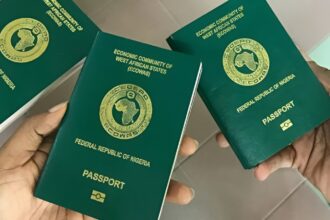

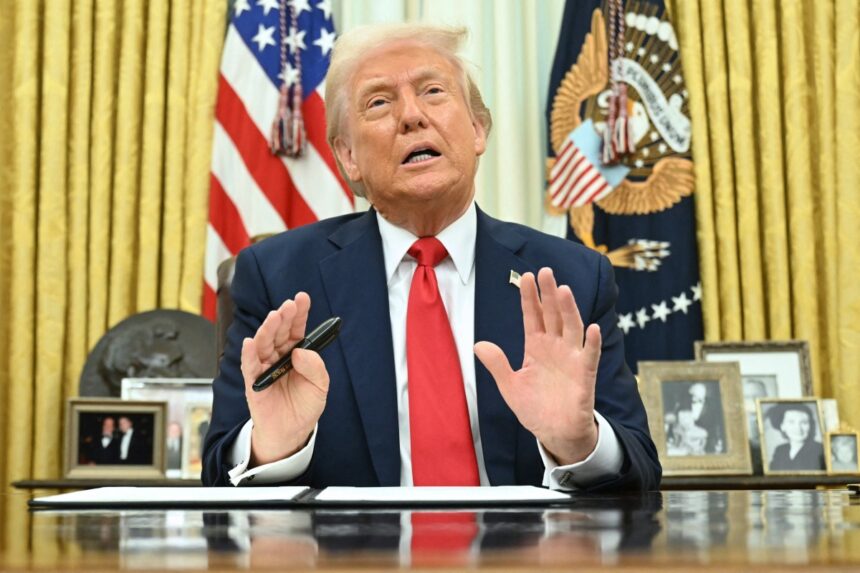
In another major shake-up to the immigration system of the United States, the U.S President Donald Trump has ordered that Nigerians and other nationals applying for green cards must now return to their home countries before their applications can be successful.
Under the latest directives, the administration is set to heavily enforce measures that require temporary visa holders from specific restricted nations to return to their places of origin to complete their permanent residency applications.
This sweeping adjustment directly impacts thousands of applicants, fundamentally rewriting rules for Nigerians and other nationals applying for U.S and green cards.
The directive stems from an expansion of Presidential Proclamation 10998, which placed Nigeria and 18 other nations on a “partially restricted” list.
Before now, foreign nationals living legally in the United States on temporary work or student visas could utilize a process known as “Adjustment of Status” (I-485) to transition to legal permanent residency without leaving American soil. However, immigration authorities are now tightening these holdover paths, shifting the burden back to foreign consular offices.
According to a press statement issued by the US Citizenship and Immigration Services, the agency said the policy was aimed at restoring what it described as the “original intent” of U.S immigration law.
The statement noted that immigrants seeking adjustment of status would now be required to process their residency applications through U. S consular offices abroad under the supervision of the United States Department of State.
The agency stated: “We’re returning to the original intent of the law to ensure aliens navigate our nation’s immigration system properly. From now on, an alien who is in the U.S. temporarily and wants a Green Card must return to their home country to apply, except in extraordinary circumstances.”
USCIS spokesman, Zach Kahler, said the policy would help reduce the number of migrants remaining illegally in the country after unsuccessful residency applications.
“This policy allows our immigration system to function as the law intended instead of incentivising loopholes. When aliens apply from their home country, it reduces the need to find and remove those who decide to slip into the shadows and remain in the U.S. illegally after being denied residency,” Kahler said.
The agency explained that the policy would particularly affect temporary visitors such as students, tourists, and workers who enter the U.S. on non-immigrant visas.
“Nonimmigrants, like students, temporary workers, or people on tourist visas, come to the U.S. for a short time and for a specific purpose. Our system is designed for them to leave when their visit is over. Their visit should not function as the first step in the Green Card process,” the statement added.
USCIS further argued that routing residency applications through consular offices abroad would free up limited agency resources to focus on other immigration priorities.
The statement added that the agency would be able to dedicate more attention to applications involving victims of violent crimes, human trafficking cases, naturalisation requests, and other immigration services under its jurisdiction.
“The law was written this way for a reason, and even though it has been ignored for years, following it will help make our system fairer and more efficient.”
Pan-Atlantic Kompass reports that the new directive mandating Nigerians and other nationals applying for green cards to return to their home countries is expected to introduce massive financial and logistical disruption for hundreds of thousands of legal immigrants.
For Nigerian professionals, students, and families, the impact is multi-layered.
Nigeria is one of the countries that supplies a large number of highly skilled healthcare, tech, and corporate workers in the United States.
Many Nigerians reside on H-1B or L-1 corporate visas while awaiting green cards sponsored by their employers.
Mandating these workers to return to Nigeria means they could face extended absences from work, which could lead U.S employers to terminate contracts due to prolonged uncertainty.
It could also lead to massive economic disruptions for high-growth sectors, particularly Silicon Valley tech startups and medical systems relying on international talent.
Similarly, the order arrives alongside previous tight measures targeted at Nigerian travelers. The U.S State Department had already revised its visa reciprocity policy for Nigeria, shifting most non-immigrant visas to single-entry with a three-month validity. Furthermore, restrictions require certain visitors to post a compliance bond of up to $15,000.
Also, mandating a Nigerian resident to leave the U.S to wait out a green card processing queue in Lagos or Abuja means navigating a severely backed-up consular system with no guarantee of when—or if—they will be allowed to return.
Additionally, the policy applies regardless of whether the applicant has a U.S. citizen spouse or children. Families now face the agonizing choice of prolonged physical separation or uprooting children from schools to move back to their home countries indefinitely.
Recall that in December 2025, Trump temporarily halted the processing of green card and citizenship applications filed by Nigerians and nationals of other countries newly added to the U.S travel ban.
The suspension affects legal immigration applications handled by the USCIS and mainly targets immigrants from selected African and Asian countries.
Many of those affected are already living legally in the United States and were seeking to adjust their immigration status or become American citizens.
Also, the Trump administration directed USCIS to freeze all immigration petitions, including applications for permanent residency and citizenship, from nationals of 19 countries covered by the travel ban announced in June.