
Three years into President Bola Ahmed Tinubu’s administration, his economic reforms remain at the center of national debate.
On May 29, 2023, Tinubu assumed the presidency of Nigeria with a declaration that “Subsidy is gone.”
It was a radical declaration that immediately signaled a departure from decades of macroeconomic management.
Today marks exactly three years since that shift. As the nation reflects on Tinubu’s third anniversary, the efficiency of his economic policies is being debated by Nigerians.
Pan-Atlantic Kompass in this report evaluates Tinubu’s economic reforms and whether they have paid off for Nigerians.
To understand the current state of Africa’s most populous nation, one must examine the raw data.
Tinubu’s administration inherited a severely weakened economy characterized by a fiscal deficit at 5.4% of Gross Domestic Product (GDP), dwindling net foreign reserves, a severely mispriced currency, and a fuel subsidy regime that was reportedly swallowing over ₦18.4 billion daily.
A granular evaluation of Nigeria’s primary economic indicators reveals an economy that has stepped back from the edge of fiscal collapse, moving steadily toward macroeconomic stabilization, yet still battling severe cost-push pressures.
Below are some of the economic indices under Tinubu;
1. Gross Domestic Product (GDP) Growth
The trajectory of Nigeria’s GDP indicates a steady, resilient recovery. Following the initial policy shocks of late 2023 and 2024, the economy found its footing. National Bureau of Statistics (NBS) figures show that real GDP grew by 4.0% over the course of 2025.
Crucially, data from the first quarter of 2026 highlights a year-on-year real GDP growth of 3.89%, an increase from the 3.13% recorded in Q1 of 2025. This expansion is heavily underpinned by the non-oil sector, which contributed 96.08% to the nation’s real GDP. Manufacturing expanded by 3.29% year-on-year, while the construction sector nudged its contribution up to 4.85%. The real growth of the oil sector also improved to 2.57% in Q1 2026, up from 1.87% in the corresponding period of 2025, driven by improved security in the Niger Delta and stabilized production.
2. Inflation and Consumer Price Index (CPI)
Headline inflation peaked at 33.2% in 2024 but moderated to around 23% in 2025 and further to 15.1–15.69% by early-to-mid 2026 (with rebasing of the CPI basket affecting readings). Food inflation, a major pain point, has eased but remains elevated due to transport costs, insecurity in farming areas, and global factors. The Central Bank of Nigeria’s aggressive monetary tightening (policy rate up to 27.25–27.5%) helped anchor expectations, though high interest rates constrained credit to the real sector.
3. Currency Valuation and Foreign Exchange (FX) Stability
The unification of the foreign exchange windows was designed to eliminate massive arbitrage, which the presidency claimed cost the country over ₦8 trillion in the three years preceding the reform.
The Naira has established a relatively stable trading band between ₦1,350 and ₦1,519 per US Dollar. While this represents a monumental devaluation from the pre-2023 peg of ₦460/$1, some will argue that the elimination of double exchange rates (official rate and black market rate) has successfully restored predictability for international trade and corporate planning.
4. Foreign Reserves and Capital Importation
This is perhaps the most undisputed victory of Tinubu’s economic reforms. In 2023, Nigeria’s net foreign reserves were depleted, with some independent reports pinning liquid balances dangerously low.
Recent CBN data shows figures like $49.26 billion as of May 25, 2026, with earlier peaks reaching $50.45 billion in February 2026 (the highest in over 13 years).
5. Fiscal Deficit and Debt-Servicing
On the fiscal side, the removal of the petrol subsidy, which was said to have swallowed over ₦4 trillion in 2022 alone, and the implementation of the national tax harmonization agenda have widened the government’s fiscal space. The federal fiscal deficit has been halved, dropping from a suffocating 5.4% of GDP down to a manageable 3.0% of GDP in 2026.
The Debate: Arguments For and Against the Reforms
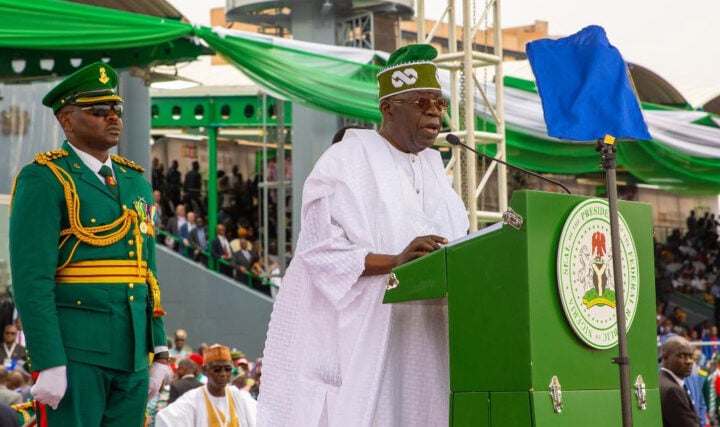
Celebrating his third anniversary in office, Tinubu, on Friday said the economic sacrifices from Nigerians in the past three years have not been in vain.
Making a case for his administration, Tinubu said the economic situation which he inherited from his fellow party man, late Muhammadu Buhari was in shambles.
The president noted that the situation demanded urgent and courageous action, noting that if his administration had failed to act, the country “would have drifted toward fiscal breakdown, worsening poverty, and severe economic uncertainty”.
“Together, we chose reform over ruin and decisiveness over hesitation. We chose long-term national recovery over short-term comfort,” he said.
“These decisions came with sacrifice. The rising cost of living triggered by our measures placed enormous pressure on families, workers, and businesses.
“Young people searching for jobs felt discouraged. Many questioned whether these difficult decisions would lead to a better future.
“I remain deeply conscious of those sacrifices, and I assure you: your sacrifices have not been in vain. And today, I can say with confidence that Nigeria has stabilised and is moving forward again. Across the country, visible progress is taking shape.”
Proponents of Tinubu’s administration have argued that the President had the rare political courage to perform emergency surgical operations on a dying economy.
Some of the arguments favouring Tinubu’s economic reforms have been anchored on averting imminent bankruptcy.
Many had claimed that had the fuel subsidy and foreign exchange arbitrage continued, Nigeria’s debt-service-to-revenue ratio was projected to exceed 100%, pointing toward sovereign default.
Also, those that many arguments in support of Tinubu’s economic reforms often point out that the World Bank, International Monetary Fund (IMF), and international credit rating agencies have updated Nigeria’s outlook to positive, acknowledging that the country is now a credible destination for international capital.
Conversely, critics argue that the administration implemented highly aggressive policies without adequate compensatory cushions, plunging millions into extreme poverty.
This argument was contained in former Vice President Atiku Abubakar’s statement issued on Friday, as Tinubu celebrates his third year in office.
Atiku declared that “the era of political complacency, propaganda and governance by deception is drawing to a close” and that Nigerians are preparing to reclaim their country through the power of the ballot.
Atiku said the most fitting report card of the Tinubu years is not the glossy advertisements, expensive media campaigns, or self-congratulatory speeches emanating from Abuja, but the tears of hungry families, the despair of unemployed youths, the collapse of businesses, and the haunting images of schoolchildren being abducted by criminals while a complacent government looks the other way.
According to him, while every government is entitled to its own opinions, no government is entitled to its own facts.
“Three years ago, President Tinubu promised renewed hope. What Nigerians have received instead is renewed hardship, renewed insecurity, renewed poverty, and renewed hopelessness,” Atiku said.
He said food prices have skyrocketed beyond the reach of ordinary families, inflation has become a cruel tax on the poor, small and medium-scale businesses are shutting their doors, the naira has been battered, and purchasing power has collapsed.
Meanwhile, some of the primary arguments against Tinubu’s economic reforms include:
Severe Erosion of Purchasing Power: The astronomical rise in the price of Premium Motor Spirit (PMS)—from ₦197 per liter in May 2023 to well over ₦1,300 per liter—triggered an immediate escalation in transport fares and food costs. For the middle class and low-income earners, real wages have collapsed.
High Cost of Doing Business: While the macroeconomy has stabilized, the central bank’s high interest rate policy (26.5%) has made commercial borrowing prohibitive for small and medium enterprises (SMEs). Simultaneously, energy costs continue to cripple local manufacturing plants, forcing several multinationals to restructure or downsize operations.
A Swelling National Debt Profile: Despite promises of fiscal restraint and a reduced reliance on borrowing, the national debt stock has ballooned since the administration took office.
- Domestic Debt: Jumped from ₦48.31 trillion in June 2023 to ₦80.49 trillion by December 2025, marking a massive ₦32.17 trillion (+66.6%) increase.
- External Debt: Rose from $43.16 billion in June 2023 to $51.86 billion by December 2025, an increase of $8.70 billion (+20.2%).
Critics argue that this massive debt accumulation contradicts the goal of achieving true fiscal independence.
Stabilization Without Structural Transformation: Leading local economic consultancies point out that while the administration has achieved financial stabilization, it has yet to achieve genuine structural transformation. Nigeria’s economy remains structurally fragile, overly dependent on oil revenues, and deeply sensitive to external global shocks. A perfect example is how Nigerians bore the cost of the ongoing crisis in the Middle East because of the high cost of oil prices.
The Lag in Social Safety Nets: Critics emphasize that palliative measures, cash transfers, and minimum wage adjustments have been slow, bureaucratic, and largely insufficient to counter the immediate inflationary sting of the reforms.
The Verdict at Year Three
Ultimately, the three-year of Tinubu’s economic reforms presents a complex paradox. Statistically, the macro-indicators prove that the administration’s defensive fiscal policies have successfully corrected dangerous structural distortions.
The surge in foreign reserves to $50 billion, the contraction of the fiscal deficit, and steady GDP growth of nearly 4% demonstrate an economy building a resilient, sustainable foundation.
Yet, for the average Nigerian household, these numbers offer little immediate comfort.
True success will be measured not just by GDP percentages or reserve figures, but by reduced poverty, job creation, and improved living standards.
The stark reality of 2026 is that macroeconomic stabilization has occurred at a massive human cost.