
Three days after a livestream glitch at a diplomatic ceremony in Pretoria, South Africa, Nigerians are divided over whether High Commissioner to South Africa Femi Fani-Kayode defended the country’s honour or turned a technical hitch into a diplomatic brawl.
Some Nigerians have hailed his assertiveness as a necessary defence of national dignity amid long-running tensions, while others brand it undiplomatic theatre that risks further straining already fragile relations.
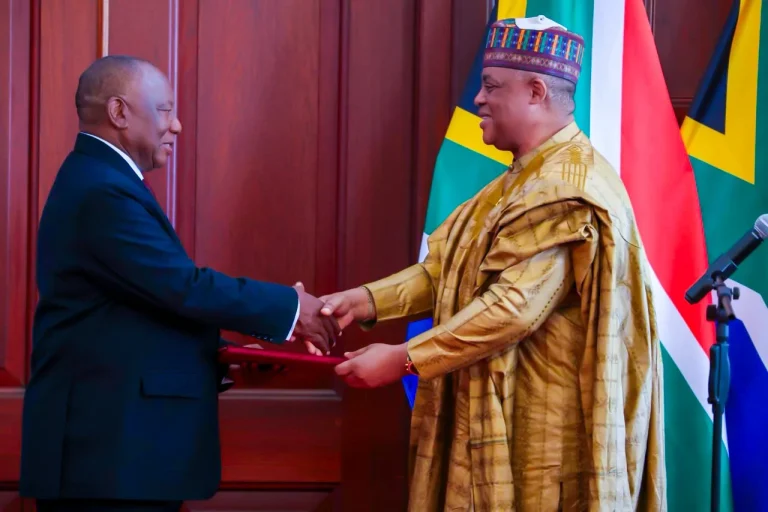
On Friday, 13 November 2026, Fani-Kayode and 14 other ambassadors presented their letters of credence to President Cyril Ramaphosa at the Sefako M. Makgatho Presidential Guest House in Tshwane.
The ceremony was livestreamed on the South African presidency’s YouTube channel and covered by the South African Broadcasting Corporation (SABC).
Fani-Kayode, who is also accredited to Lesotho and Eswatini and is the first substantive Nigerian ambassador to South Africa in four years, alleged that Nigeria was the only country whose introduction and speech were cut from the livestream broadcast. He said the livestream was interrupted around the time of the French ambassador’s remarks and resumed only after he had finished speaking.
In posts and statements, Fani-Kayode described the omission as deliberate, claiming “some elements in South Africa do not want to hear what we have to say or see our faces.”
He said he raised the matter directly with Ramaphosa during a photo session; the president, he claimed, questioned officials and ordered them to resolve it, though by then it was too late.
He declined an SABC interview request, citing the “deplorable way” the Nigerian delegation had been treated. South African authorities later released a separate video of his speech.
A South African Presidential spokesperson, Vincent Magwenya, accused the envoy of misrepresenting events.
He said Ramaphosa did not, and constitutionally cannot, direct the state broadcaster SABC, and only pointed the envoy to the appropriate official. He also said Fani-Kayode refused to speak to SABC’s Sophie Mokoena, who could have cleared up the misunderstanding.
Magwenya wrote that “a lie remains a lie” and told the envoy to stop disgracing himself and his country.
The Nigerian High Commission replied on X. It told Magwenya, “You are the disgrace and no-one else.” It insisted Ramaphosa personally intervened, called Magwenya’s response provocative and diplomatically inappropriate, and suggested his remarks were part of a pattern.
The mission also accused him of earlier remarks against the Nigerian and Ghanaian presidents over concerns about xenophobia. SABC later said it covered the ceremony on its own channels. It did not explain why his remarks were absent from the Presidency’s feed.
Reacting to the livestream episode between Fani-Kayode and the South African presidency, former Deputy Permanent Representative of Nigeria to the United Nations, Ambassador Usman Sarki, cautioned against assuming that the omission was deliberately intended to undermine Nigeria or its representative.
According to him, the presentation and acceptance of diplomatic credentials constitute a formal act between sovereign states, while broadcasting the ceremony is essentially a matter of public communication.
“An interruption in transmission, however unfortunate, does not necessarily amount to an official diplomatic affront,” he said.
Sarki said Fani-Kayode should have first established the facts and sought clarification from the relevant South African authorities, particularly those responsible for presidential protocol and broadcasting arrangements, before deciding on a public response.
“Both countries owe it to themselves, and indeed to the African continent, to conduct their relations with the maturity, respect and sense of responsibility commensurate with their standing on the continent,” he said.
Another diplomat and former Nigerian ambassador to Côte d’Ivoire and Sudan, Ambassador Suleiman Dahiru, described the face-off as unfortunate and unnecessary, saying the matter could have been handled through established diplomatic channels.
“It shouldn’t have happened in the first place. I learnt that about 15 ambassadors were scheduled to present their letters of credence to President Ramaphosa, and our ambassador was 14th in the order of presentation. It is not an issue that should be blown out of proportion, let alone taken to social media,” he said.
Dahiru said the Nigerian High Commissioner should have formally communicated his concerns to the South African government in a respectful manner rather than engaging in a public exchange.
“The High Commissioner should have written to the government of his host country, explaining his concerns about what transpired respectfully and diplomatically, not the other way round.
“Resorting to exchanging words on social media is not an appropriate way to handle the issue. It is unfortunate,” he said.
Another retired diplomat, Ambassador Mohammed Ibrahim Kawu, said Fani-Kayode should respect the authorities of his host country and should have channelled his grievances on the livestream omission through appropriate diplomatic means.
“Fani-Kayode should respect his host country and communicate his grievances through the appropriate channels and in a diplomatic manner. What he did was wrong and unfortunate, especially coming from a diplomat. It was an entirely undiplomatic approach.
“How can you go to a country and disrespect its authorities while exchanging views on social media?” he asked.
On the other hand, some Nigerians read the livestream omission as part of a larger pattern.
The development occurred amid xenophobic attacks in South Africa. Recall that thousands of Nigerians have been evacuated from South Africa amid a wave of attacks on African immigrants.
Shehu Sani, former senator representing Kaduna Central, has thrown his weight behind Fani-Kayode.
In a post on Sunday, the former senator described Fani-Kayode as the best choice to represent Nigeria in the African country, citing his distinctive personality.
“Fani Kayode is the best choice for South Africa at this material time,” he wrote on X.
“They need someone who can switch to any mode when the occasion demands it. If you speak diplomacy, you get diplomacy; if you speak ‘sakiya ’, you get ‘Sakiya’.”
Below are some other reactions from Nigerians on X;