

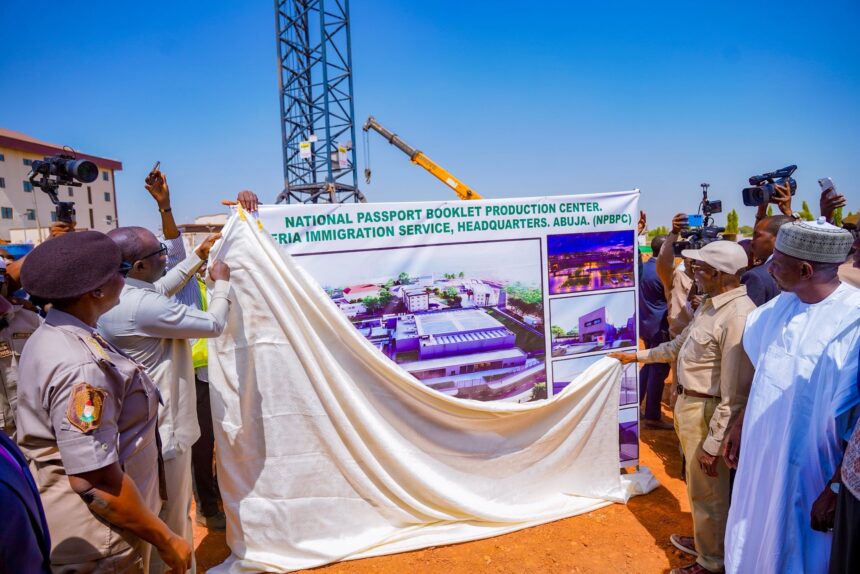
Nigeria is set to join the ranks of just three other African nations capable of manufacturing their own passport booklets after the Federal Government broke ground on a $70m National Passport Booklet Production factory in Abuja.
Interior Minister Olubunmi Tunji-Ojo announced the project during the groundbreaking ceremony at the Nigeria Immigration Service (NIS) headquarters on Airport Road, Sauka.
The $70m factory is scheduled for completion and commissioning in May 2027 and will enable full local production of electronic (e-) passport booklets.
According to the minister, only three African countries currently manufacture passports in-country: South Africa, Ethiopia and Algeria.
Once operational, Nigeria will become the fourth. It will also be the first nation in West Africa with domestic e-passport manufacturing capacity.
Tunji-Ojo noted that of the existing three producers, only Ethiopia currently has the ability to manufacture full electronic passports with biometric chips. South Africa and Algeria primarily produce more basic A-series booklets.
The new $70m passport factory of Nigeria will focus on high-security e-passports meeting international and ECOWAS standards.
The centre, developed in partnership with technology firm Iris Smart Technologies, is designed as an off-grid, artificial intelligence-driven facility sitting on 1.1 hectares.
It will start with an annual production capacity of six million passport booklets, with plans to scale to 10 million. Nigeria’s current yearly requirement stands at roughly 1.8 million to 2 million booklets. The surplus is intended to serve other ECOWAS countries and potentially the wider African market, which currently relies heavily on suppliers from Europe and the Americas.
The minister said: “When delivered, this project will complete the full localisation of the Nigerian passport value chain. We began in 2023 by automating the application and approval processes. In 2024, we moved to the contactless biometric passport application system, and in 2025, we established the passport personalisation centre. Today, we break ground on the final stage: the manufacturing plant itself.
“This $70m factory, which sits on 1.1 hectares of land, is AAI-drivenand completely off-grid. By May 2027, it will give Nigeria the capacity to produce six million passport booklets annually, scalable to ten million.
“Beyond meeting our domestic demand of roughly two million booklets a year, it positions Nigeria to export to neighbouring nations that currently source their passports from Europe and the Americas. It also makes our dear country the first in West Africa with an e-passport manufacturing plant, and only the second on the African continent with full e-passport production capacity.
“Under this administration, Nigeria will no longer import the sovereign document that carries our identity, and the price of the passport will no longer be dictated by foreign exchange rates.
“When our government assumed office, the Nigeria Immigration Service had no data centre of its own. Today, it operates one of the most advanced facilities in the country, public or private. We inherited an agency that could not pre-profile travellers; now, the API and PNR systems are live.
“We cleared a backlog of 204,332 passports that had lingered for years. Contactless diaspora renewals are now operational. The e-visa platform is fully functional. E-gates now operate at our major airports.”