
A two-term governor of Anambra State and a 2027 presidential aspirant, Peter Obi has raised an alarm, claiming that some Nigerians facing xenophobic attacks in South Africa prefer to die rather than return home.
According to Obi, many Nigerians enduring repeated attacks in South Africa prefer to die rather than return home due to dire conditions back in Nigeria.
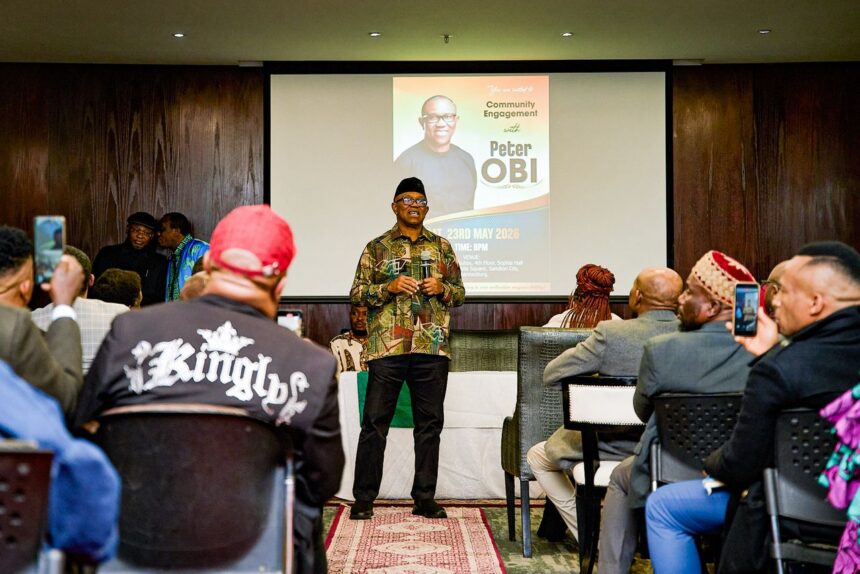
Obi made the statement after returning from a high-level visit to South Africa, where he engaged directly with affected Nigerians and South African officials amid fresh waves of xenophobic violence targeting foreigners, particularly Nigerians.
Pan-Atlantic Kompass reports that during his recent trip, Obi addressed Nigerians in South Africa who have borne the brunt of xenophobia.
He disclosed that efforts were made to facilitate their return home, including providing necessary facilities and support.
However, he said the response from many was heartbreaking, adding that they preferred to stay and face potential death rather than come back to Nigeria.
This was also contained in a statement issued by the NDC media team on Tuesday.
“I recently returned from South Africa and interacted with Nigerians there. Many of them said they would rather remain there, despite the challenges, than return home because things are tougher in Nigeria,” Obi said.
He stated that if governance and economic opportunities were functioning properly in Nigeria, large numbers of citizens would not be forced to migrate to other countries in search of survival.
The former governor also disclosed that he held meetings with political leaders in South Africa, including former South African President Thabo Mbeki, to discuss ways of improving relations between South Africans and foreign African nationals.
Obi said the discussions focused on reducing tensions and promoting peaceful coexistence amid recurring xenophobic incidents targeting foreigners.
He further criticised the Federal Government for what he described as inadequate diplomatic engagement on issues affecting Nigerians abroad.
According to him, some foreign leaders admitted that Nigerian authorities rarely intervene or engage consistently on behalf of citizens facing hardship outside the country.
“It is painful that Nigerians face challenges in many countries and our government is often absent when support is needed most,” he said.
“If your own country does not stand up for you, it becomes difficult to expect others to do so.”
Obi also expressed concern over Nigeria’s deteriorating security situation, noting that the country once played a prominent role in international peacekeeping missions but now struggles with internal insecurity.
“Nigeria was once respected globally for its peacekeeping contributions, but today we are battling insecurity across different parts of the country. That should concern every citizen,” he added.
Violent anti-foreigner protests erupted in cities such as Pretoria, Johannesburg, Durban, East London, and parts of KwaZulu-Natal, resulting in harassment, looting, property damage, and injuries.
This has triggered fear and panic within the diaspora community, with the Nigerians in Diaspora Commission directing Nigerian business owners to temporarily shut down to minimise risks and avoid losses.
The protests, according to reports, are being driven by community groups, anti-immigration organisations, and social movements such as Operation Dudula, the March and March Movement, and similar local initiatives, often under the banner of tackling illegal immigration and unemployment.
The demonstrations are organised by groups accusing migrants of causing economic hardship and crime, with activists demanding the deportation of undocumented foreign nationals, particularly those from African countries such as Nigeria, Ghana, Zimbabwe, Mozambique, and Somalia.
Recall also that the Nigerian Consulate General in Johannesburg recently confirmed that the two victims, Amaramiro Emmanuel and Ekpenyong Andrew, were killed in separate incidents linked to the attacks.
The Consul-General, Ninikanwa Okey-Uche, disclosed in a statement on Monday that Emmanuel died from injuries allegedly sustained after being beaten by personnel of the South African National Defence Force on April 20.
Andrew, she said, was apprehended on April 19 in the Booysens area of Pretoria following an alleged altercation with members of the Tshwane Metro Police, and his body was later discovered at the Pretoria Central Mortuary.