

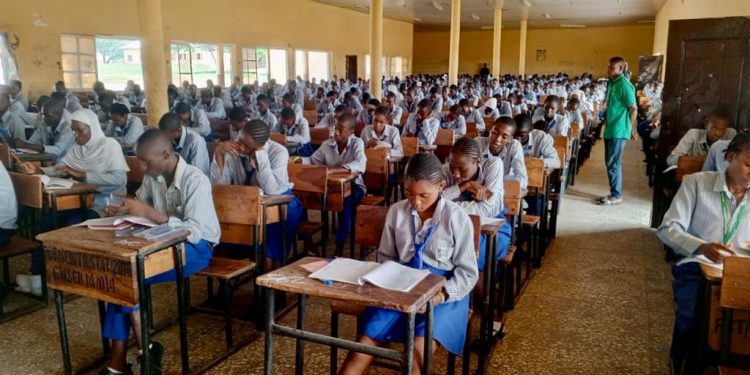
The Federal Government of Nigeria has announced a move to scrap the long-standing JSS-SSS separation policy.
Education Minister Dr. Tunji Alausa revealed the plan on Tuesday, June 30, 2026, during the inauguration of the Ministerial Implementation and Monitoring Committee of the Universal Basic Education Commission (UBEC) in Abuja.
He explained that the move to scrap the JSS-SSS separation policy is aimed at addressing what he described as Nigeria’s alarming out-of-school children crisis, with data showing that over 20 million pupils who started primary school never progressed to senior secondary education.
“We’re seeing data from, say, like Kaduna and other northern states, because you have one principal for junior secondary schools and another principal for senior secondary schools,” Alausa said.
“We have overflowing JSS and empty senior secondary schools. So, I can objectively report today that this disarticulation policy has failed. We will phase it out.
“We can’t be creating positions because we want to create a director level for people while we harm our education system. It’s not right. It’s about doing what is good for every Nigerian child.”
Alausa said the policy has also brought about a huge enrolment gap between primary and secondary school education levels.
According to him, over 20 million children who began their education in primary school failed to progress to senior secondary school after dropping out along the way.
“We have 20 million dropouts from primary school to JSS. Where are those students? And what we also noticed was that we have 80,000 public primary schools, and junior secondary schools, we have just about 15,000 that ratio is one to eight,” Alausa said.
“And if you look at the completion rate. So, it’s us as a government not doing what we need to do, but the previous government might have failed in this regard, but this government will not fail.
“We’re fixing this, so we need to open up as many more opportunities for students to attend these schools, primary schools’ infrastructure. This disarticulation policy has also contributed to this.”
What Is the JSS-SSS Separation Policy (Disarticulation)?
Introduced years ago, the “disarticulation policy” required JSS (typically JSS 1-3) and SSS (SSS 1-3) to operate as distinct entities — often with separate:
- Physical facilities or campuses
- Administrative structures and principals
- Management and oversight
This created a clear break after JSS 3, where students often needed to transition to a different school for senior secondary.
Why is the Government Moving to Scrap JSS-SSS Separation Policy?
The 1-to-8 School Ratio Crisis: Nigeria currently has about 80,000 public primary schools, but only 15,000 junior secondary schools. This creates an unsustainable bottleneck. Millions of children finish primary school but literally have no physical classrooms to transition into for junior secondary learning.
The 20 Million Drop-Out Bottleneck: Out of roughly 24 million children who enroll in primary education, a staggering 20 million drop out before finishing senior secondary school.
Administrative Bloat vs. Classroom Reality: The separate system resulted in overcrowded, overflowing JSS facilities alongside underutilized, near-empty senior secondary classrooms. Minister Alausa criticized the old structure for prioritizing the creation of bureaucratic director-level positions for school heads over the actual structural needs of the students.
How Will the New System Work?
If approved, the changes would phase out the strict separation, allowing:
Unified Secondary Schools: JSS and SSS could operate under one roof or administration, similar to how many primary schools function continuously.
Smoother Transitions: No major break after JSS 3 — students stay in the same environment, reducing disruption.
Better Resource Allocation: Existing facilities would be optimized, potentially expanding access without massive new builds.
Compulsory Focus: This aligns with broader pushes toward longer basic education, making more of secondary schooling seamless and compulsory.
Pan-Atlantic Kompass reports that this proposal does not immediately eliminate JSS or SSS as stages of learning.
Students would still progress through the curriculum (now updated with more vocational and skills focus from recent reforms), but the administrative and physical barriers would be removed.
A position paper will go to the next National Council on Education (NCE) meeting for discussion and potential approval.