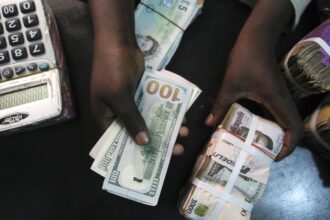


Nigeria’s external reserves, which was once celebrated as a symbol of a healthy economy in Africa’s most populous country, have taken a plunge since former President Olusegun Obasanjo left office in 2007, dropping from the $45 billion mark to $38.8 billion in 2024.
Recent information from the Central Bank of Nigeria (CBN) has revealed that this marked a huge contrast when compared to the legacy in sums left behind by Obasanjo when he exited office about 18 years ago. This underpins the nation’s economic redundancy rather than gains, despite all its petrodollar earnings.
Figures show that when Obasanjo assumed office in 1999, Nigeria’s external reserves stood at $3.7 billion, with a crippling $36 billion debt overhang.
Through strategic economic reforms and persistent diplomacy, Obasanjo’s administration transformed Nigeria’s fiscal landscape during the time under review.
Checks revealed that Obasanjo’s global shuttle diplomacy secured $18 billion in debt relief from the Paris Club, reducing Nigeria’s external debt.
Aside from reducing the debt profile of the country, Obasanjo’s administration established the Excess Crude Account (ECA), established in 2004.
The ECA saved oil revenues above budget benchmarks, accumulating $25 billion by 2007. Combined with $45 billion in reserves, Nigeria’s savings reached a total of $70 billion.
By May 2007, when Obasanjo left office, Nigeria’s external reserves peaked at $45 billion, a remarkable 845% increase from 1999, according to official data from the CBN.
Speaking on the development during an interview in 2024, Obasanjo said: “When I came in 1999, I met $3.7 billion in reserve. And as I told you, we were spending $3.5 billion to service debt. That’s how we had. By the time I left eight years later, with debt relief.
“When I came in, we had a debt overhang of close to $36 billion. By the time I left, with the debt relief and clearing what we had to clear, the quantum of debt that I left was about $3.5 to $3.6 billion from over $3.6 billion or around $36 billion. At the same time, the reserve that was $3.7 billion went to $45 billion.”
This means Obasanjo’s successor, late former president Umaru Musa Yar’Adua inherited huge external reserves.
Although, Yar’Adua inherited a strong economy, his administration faced challenges that began eroding the foreign reserves.
Checks also revealed that by September 2009, Nigeria’s external reserves hit a historic $62 billion, majorly said to be driven by high oil prices and residual Obasanjo-era savings.
However, the depletion of Nigeria’s external reserves began when state governors during that period, citing constitutional provisions, demanded ECA funds. An out-of-court settlement in 2009 reduced the ECA from $15 billion to $6.5 billion.
Also, between 2008–2009, global oil demand plummeted, impacting Nigeria’s oil-dependent revenues. Reserves dropped to $42.4 billion by May 2010.
Yar’Adua’s tenure saw reserves fluctuate but ended with a decline due to ECA withdrawals and external shocks.
On the other hand, Goodluck Jonathan’s administration coincided with an oil price boom, yet reserves plummeted significantly:
From $42.4 billion in 2010, Nigeria’s external reserves fell to $28 billion by May 2015, despite high oil prices averaging $100 per barrel.
Governors’ demands continued during Jonathan’s administration, reducing the ECA to $2 billion by 2015.
In 2014 oil price collapse slashed revenues, forcing reserve drawdowns to defend the naira and service debts.
Jonathan’s tenure saw reserves drop by 34%, despite favourable oil prices for much of his term.
While Jonathan presided over a robust external reserve profile, his administration left behind $28.5 billion in external reserves by the time he left office in May 2015, with an additional $2.07 billion in the Excess Crude Account.
The immediate past president, Muhammadu Buhari, met an external reserve of $28.5 billion when he became president on May 29th, 2015.
Under Buhari, the CBN introduced an incentivized interest rate policy that offered high interest rates in exchange for importing dollars into the country.
This policy helped swell the external reserves to as high as $47 billion in 2019, the highest level since 2013.
However, Nigeria’s external reserves further plummeted as the country faced economic recessions in 2016 and 2020.
Also, public debt soared 658% from 2007 to N26.9 trillion by 2021, with external debt at $81.27 billion by 2019. Reserve drawdowns funded debt servicing.
Data from the CBN revealed that by the time Buhari left office in 2023, Nigeria’s foreign reserves stood at $36.6 billion.
Since President Bola Tinubu took office in May 2023, efforts to rebuild reserves have shown mixed results:
Although the CBN reported an increase from $36.6 billion in 2023 to $38.8 billion in 2024, Nigeria’s external reserves continue to be far off from expectations.
According to a financial report released by the apex bank, the increase was attributed to the improved inflows from portfolio investors, diaspora remittances, and federal government receipts.
“This is largely attributable to improvement in accretion to external reserves from portfolio investors, diaspora remittances, and federal government receipts following improvement in the confidence in the economy facilitated by better coordination with the Nigerian National Petroleum Company (NNPC) and diaspora engagement strategies. Also, proper investment management decisions are aimed at boosting the reserves of the bank.
“This performance reflects the CBN’s firm commitment to external sector stability, ensuring Nigeria is better positioned to meet its international obligations, stabilise the Naira, and boost macroeconomic confidence,” the apex bank’s statement partly read.