
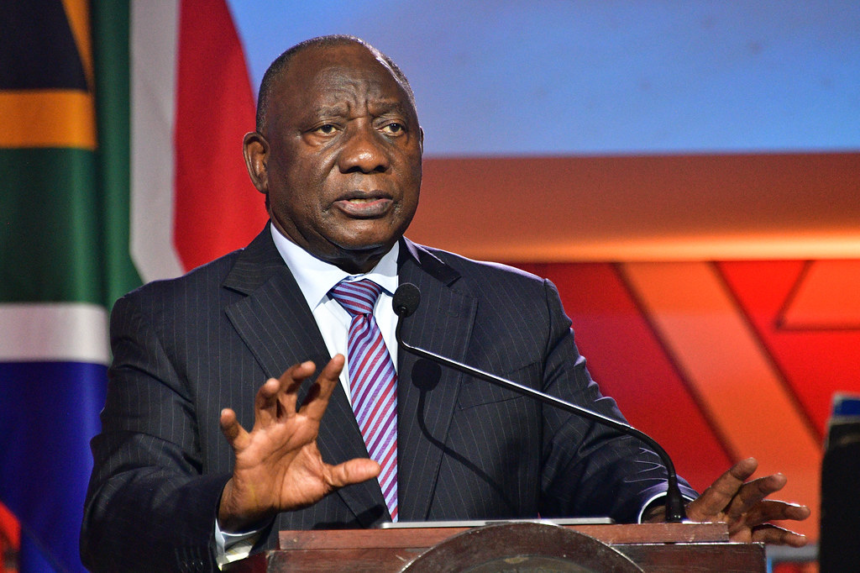
South African President Cyril Ramaphosa has declared that illegal migration is fuelling xenophobic attacks across the country.
According to him, illegal migration is creating a volatile environment that threatens South Africa’s social stability and international standing.
While acknowledging the legitimate frustrations of citizens over strained public services and a tightening labor market, Ramaphosa emphasized that vigilantism is not the solution. He noted that agitations against illegal migration have been exploited by “opportunists” who engage in xenophobic attacks.
The remarks are contained in a statement published Monday on the official website of the South African Presidency.
Pan-Atlantic Kompass reports that this comes amid renewed attacks and harassment targeting foreign nationals and foreign-owned businesses in Johannesburg and surrounding areas.
Ramaphosa, however, condemned the recent violence, stressing that the attacks do not reflect South African values or government policy. He said the incidents are being driven by criminal elements exploiting socio-economic frustrations in poorer communities.
The statement reads: “The recent violent protests and criminal acts directed at foreign nationals in parts of our country do not represent the views of South Africa’s people nor reflect our government’s policy.
“These are the acts of opportunists who are exploiting the legitimate grievances, particularly those of the poor, under the false guise of ‘community activism’. Some of these people are assuming functions that only state officials are permitted to perform, including stopping people to check identification and conducting searches of private property. Such lawlessness will not be tolerated, regardless of who the perpetrators or victims are.
“At the same time, as a society, we need to deal decisively – and within the law – with the challenge of illegal immigration, which risks our social stability, governance, and national security. Undocumented migration places a strain on healthcare, housing, and municipal services, particularly in poor communities.
“It distorts the labour market. In a country with high unemployment, some employers are exploiting undocumented, cheaper foreign labour over hiring citizens and paying them legal wages. Not only is this fuelling social tension, but it is also actively undermining our labour protection regime and eroding the hard-won rights of workers.
“In tackling illegal migration, we are balancing our constitutional and international obligations with safeguarding national security.
“The Border Management Authority (BMA) and the Defence Force are strengthening border security and combating illicit cross-border activity. We commend the BMA for successfully intercepting some 450,000 people trying to enter South Africa illegally in the past financial year. As we strengthen our borders, we continue to reform our migration and citizenship framework.
“We are stepping up workplace enforcement against employers who hire undocumented foreign nationals in violation of labour and immigration laws. We announced in the State of the Nation Address that we would be hiring up to 10,000 inspectors through the Department of Labour and Employment to ensure that our labour and immigration laws are adhered to. We continue to arrest and deport undocumented foreign nationals in accordance with the law, as we take forward the fight against corruption within the immigration system.
“This is a society-wide challenge in which the private sector and government should all play a constructive part. South African citizens who collude with undocumented foreign nationals in fake marriages, the illegal sale of state-subsidised housing, or accepting bribes to facilitate access to social services only deepen the problem. Many South Africans are exploiting undocumented labour in households and in the informal sector.
“As a country, we must reject attempts to damage our country’s international reputation and to undermine the solidarity that has defined South Africa’s relations with the rest of Africa since the dawn of democracy.
“Since 1994 we have actively advanced a culture of human rights, all the while deepening the cause of African integration, cooperation, and solidarity. We have a strong refugee protection framework that prioritises the integration of persons displaced by conflict, war, and persecution.
“Refugees are not confined to camps, as happens in some other countries. In South Africa, they can live in communities, participate in the economy, and access services like healthcare and education.
“South Africa continues to play its part in deepening regional economic integration and travel. Last year alone, visitors from African countries accounted for just over 8 million of a total of 10.5 million tourist arrivals.
“South Africa invests significantly in strengthening academic, cultural, and institutional ties with the rest of Africa through hosting students and academics from Africa in our universities, through people-to-people exchanges, and through our hosting of the Pan-African Parliament.
“Our demonstrated commitment to deepening African integration and solidarity should not be undermined by isolated acts of criminality.
“South Africa is not unique in confronting the pressures associated with undocumented migration. Many countries across the world, including in Africa, are themselves grappling with similar tensions. This calls for cooperation and understanding between countries on the continent and further afield.
“Like every other country in the world, we will continue asserting our sovereign right to regulate migration, secure our borders, and enforce our laws. We must make it clear that there is no place in South Africa for xenophobia, ethnic mobilisation, intolerance, or violence.
“Everyone in South Africa is bound by the same laws and we are committed to ensuring that they are respected and upheld by citizens and foreign nationals alike.”
Recall that South Africa has faced recurring waves of xenophobic violence over the past decade, often linked to unemployment, inequality, and competition in informal markets.
These tensions have periodically escalated into attacks on foreign nationals, particularly African migrants operating small businesses in urban settlements.
The latest incidents come against a backdrop of long-standing concerns about immigration enforcement and service delivery challenges in densely populated communities. Foreign-owned shops often operate alongside local traders, sometimes leading to disputes over pricing, space, and regulation.
Recently, Nigeria has intensified diplomatic engagement over recent attacks on foreign nationals in South Africa, following the summoning of South Africa’s Acting High Commissioner by the Nigerian Ministry of Foreign Affairs over rising concerns for the safety of Nigerian citizens.
The meeting, held on Monday, May 4, was prompted by renewed reports of violence against foreign nationals and formed part of Nigeria’s push for clarity and stronger protection measures for its citizens.
The Nigerians in Diaspora Commission (NIDCOM) also raised alarm over the situation, confirming that at least two Nigerians — Amaramiro Emmanuel and Ekpenyong Andrew — were killed in separate incidents linked to anti-foreigner tensions.
Also, several African countries have begun to take steps over the rising xenophobic attacks in South Africa.